
Private label car accessories from a Chinese factory usually means you put your brand on a body kit or spoiler design the plant already runs — not that you invent the mould from scratch. OEM and ODM sit further along the same spectrum: more of your design and tooling, more cost and lead time, and clearer exclusivity if the contracts say so.
This guide is for importers, accessory shops and online stores that want to understand how private-label, ODM and OEM deals actually work for plastic body kits and spoilers. It explains process, tooling, MOQ realities, QC and IP checks. It is an industry walk-through — Marvix’s trade offer for BYD parts is wholesale of the existing catalogue (samples, stock kits, mixed SKUs and dropshipping), not a custom private-label development programme.
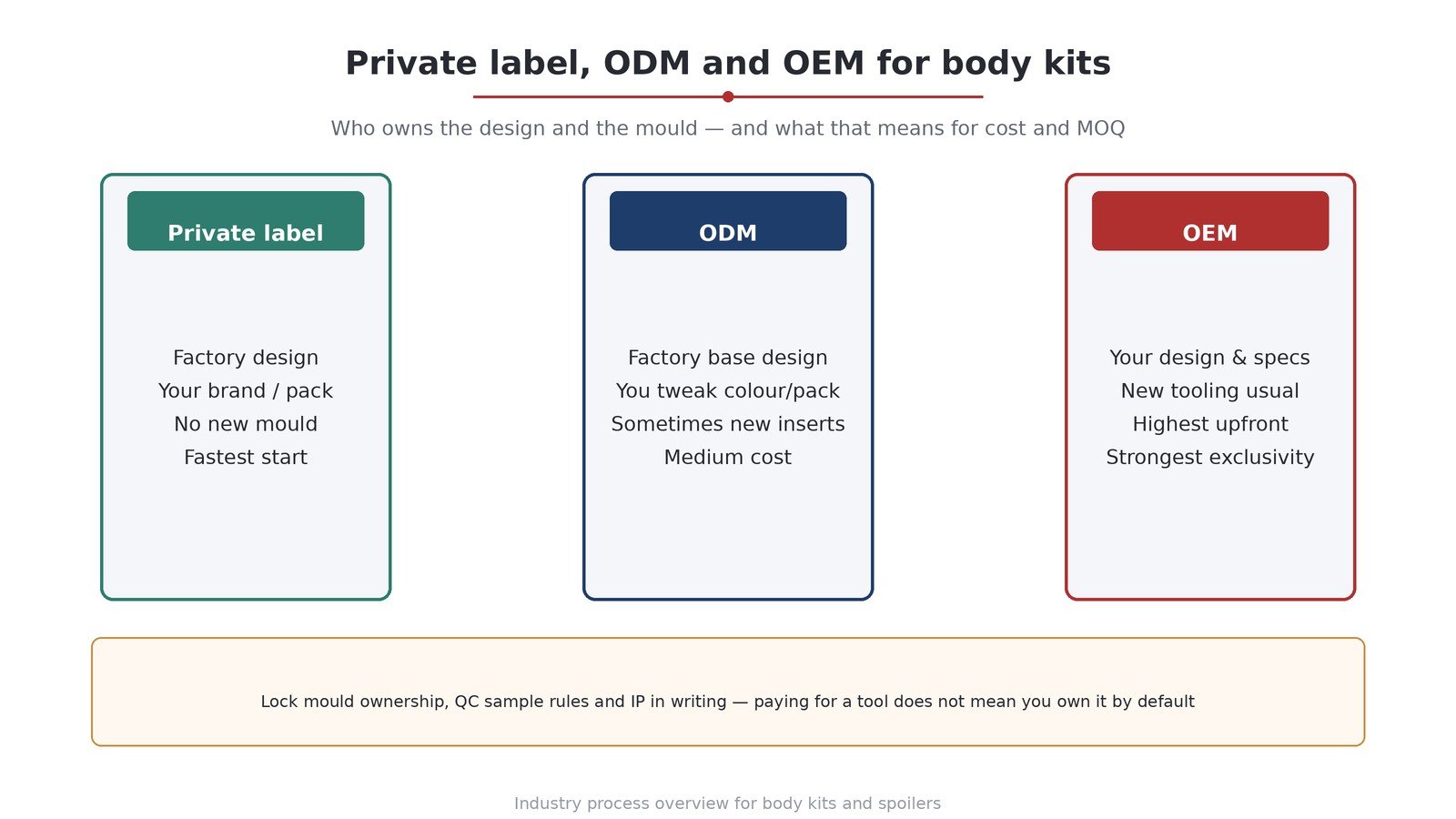
Private label vs ODM vs OEM (plain definitions)
Factories and trading companies often use these words loosely. In practice for exterior plastics:
| Model | Whose design? | New mould? | Typical start cost | Exclusivity |
|---|---|---|---|---|
| Private label | Factory’s existing kit / spoiler | Usually none | Lowest — logo, carton, inserts | Low unless you negotiate a market lock |
| ODM | Factory base design; you change colour, pack or small features | Sometimes inserts or revised cavities | Medium | Medium — still often shared base tooling |
| OEM | Your drawings and specifications | Usually yes | Highest — tooling, samples, longer NRE | Highest if ownership is written down |
A common trap: a supplier says “OEM welcome” when they only mean they can print your logo on a stock lip. That is private label branding, not engineering. Ask who owns the 3D data and who paid for the steel mould — the answers decide which row of the table you are really in.
How plastic body kits and spoilers are made
Most aftermarket lips, skirts, diffusers and spoilers sold for road cars are injection-moulded thermoplastics. ABS is common for glossy exterior styling; PP appears on more flexible lips and some kit pieces. The plant dries resin, melts it in the barrel, injects it into a steel mould under high pressure, cools the part, ejects it, then trims gates and flash. Painted or gloss-black finishes add prep, spray and cure steps after moulding.
Because geometry lives in the mould, two buyers ordering the “same” spoiler from the same tool will get the same shape. Differentiation then comes from branding, packaging, QC and which bumper year the tool was cut for — not from a unique silhouette unless you paid for OEM tooling.
Most Marvix exterior styling parts in the live catalogue are ABS, with PP on selected kits and lips. That is how stock BYD lines are produced and sold today; material for any SKU is what that product page states.
Tooling: who pays, who owns, where it lives
Injection moulds for large exterior parts are expensive relative to a first carton of kits. Industry quotes for automotive plastics commonly run from a few thousand US dollars for a simple cavity to tens of thousands for large or multi-cavity tools, with first samples often weeks after steel is cut. Those are order-of-magnitude ranges — always get a written quote for your part size.
Critical buyer checks:
- Paying for a mould ≠ owning it. Ownership must appear in the contract (and preferably on a mould plate). Possession usually stays at the factory.
- Where the tool is stored and whether you can move it if you change suppliers.
- Revision control — bumper facelifts need new steel or inserts; confirm who pays for that change.
- Sample gate — T1 / golden sample approval before mass production, with photos and dimensional notes.
Private-label programmes skip most of this because they run on the factory’s amortised tools. OEM programmes live or die on these clauses.
MOQ realities for kits and spoilers
Minimum order quantity is rarely a round marketing number. It reflects resin lot size, colour change cost, packing print runs and how much of a mould’s capacity the factory will reserve for you.
- Private label on a running BYD Seal lip or spoiler may allow smaller first orders if the plant already moulds that SKU for other channels — but printed cartons and logo plates can raise the floor again.
- ODM with a colour or pack change often sits in the mid range: enough volume to justify a special run without full new steel.
- OEM usually needs higher volume (or a higher unit price) so the tooling bill can be amortised.
Treat “MOQ 1” claims carefully for custom-branded exterior plastics. For stock catalogue wholesale — buying finished kits already tooled for BYD models — 1-piece samples and retail orders are a different commercial path and do not require you to fund a private-label mould.
QC, packaging and what to inspect
Long skirts and full-width lips fail in the carton as often as they fail on the tool. Agree before the first PO:
- Critical / major / minor defect classes (crack or wrong SKU vs cosmetic sink vs light flash on a hidden edge).
- Pre-shipment photos or a third-party inspection on the first branded run.
- Foam between gloss faces and reinforced cartons for oversized lengths.
- Part-count against the packing list — end-caps and badges go missing more often than main panels.
For how to shortlist suppliers more broadly, see how to source BYD body kits from China.
IP and brand risk (what to put in writing)
On private label and ODM, the factory typically keeps design IP for the base part. You own your trademarks, logos and artwork — register them in the markets where you sell. On OEM, you should own the design, but only if drawings, NDAs and the manufacturing agreement say so clearly.
Also write down:
- Whether the factory may sell the same unbranded geometry to other buyers (almost always yes on private label).
- Whether your carton artwork or exclusive colour is limited to your account.
- Who may keep leftover branded stock if you stop ordering.
Without those clauses, “our exclusive Seal spoiler” is a sales phrase, not a legal position.
A practical decision path for buyers
- Validate demand with stock geometry first. Sell a proven BYD Seal or Sealion kit shape under clear model naming before you fund steel.
- Add branding only when volume justifies print and packing MOQs.
- Move to ODM tweaks (colour, small feature) when customers ask for differentiation you can measure.
- Fund OEM tooling only when the product itself — not only the logo — is your competitive edge, and you can carry sample rounds and higher MOQ.
Many successful accessory brands stay on steps 1–2 for years. That is a valid strategy, not a failure to “do OEM”.
Where Marvix fits for BYD exterior parts
Marvix supplies vehicle-specific BYD exterior parts from an existing mould library and warehouse stock: body kits, lips, skirts, diffusers, spoilers and related accessories. Trade buyers use the catalogue for 1-piece samples, tiered wholesale pricing, mixed-SKU orders and dropshipping, with fitment checks from model, year, VIN or photos.
If your project needs a full private-label or OEM development contract (custom logo tooling programme, exclusive mould ownership, custom packaging line), that sits outside Marvix’s standard wholesale offer — use a dedicated OEM/ODM factory partner for that scope. For ready-to-ship BYD lines, start from the published wholesale page linked below.
Frequently Asked Questions
What does private label mean for car body kits?
It means the factory’s existing kit or spoiler design is sold under your brand, usually with your logo and carton. The mould and base geometry stay with the factory unless a separate exclusivity deal says otherwise.
What is the difference between OEM and ODM?
OEM builds to your design and usually needs new tooling. ODM starts from the factory’s design; you brand it and may change colour, packaging or limited features.
Does paying for a mould mean I own it?
Not automatically. Ownership and the right to remove the tool must be written into the contract. Ask where the mould is stored and what happens if you change suppliers.
Why are MOQs higher for custom branding?
Printed packaging, colour changes and reserved production slots all cost setup time. Stock catalogue parts that already run in volume can often ship in smaller quantities.
What should I inspect before a branded shipment leaves China?
Fit on a known bumper line, gloss or primer finish defects, foam protection on long parts, and a counted packing list. Photograph issues against agreed defect classes.
Can I start without OEM tooling?
Yes. Many shops begin by wholesaling proven vehicle-specific kits, then add branding later if sales support the packing MOQ.
Wholesale existing BYD kits with Marvix
Marvix is a one-stop BYD partner, combining a BYD vehicle-export background with parts, accessories and export logistics. 1-piece samples and retail orders are accepted, pricing is tiered for larger quantities, and listed parts are usually in stock, with orders under 100 sets shipped directly. We also support mixed-SKU orders, dropshipping and fitment checks from your model, year, VIN or photos.
We ship to all countries on EXW, FOB or DAP terms, plus DDP for samples, retail orders and dropshipping. For Brazil, Colombia and Mexico the terms are EXW, FOB or DAP only, and the buyer handles customs clearance and taxes. See BYD exterior accessories wholesale, browse BYD body kits and spoilers & wings, or request a quote.

 English
 Portuguese
 French
 Turkish
 Russian
 Arabic
 Spanish