
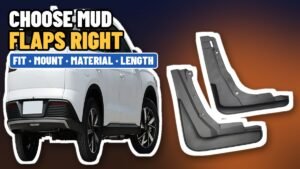
A mud flap is worth fitting when you want a panel in the path immediately behind the tyre to intercept some of the mud, water or stones your own tyres throw at the nearby body—and when a set can be matched to the car and checked for clearance. It is less useful if those panels already stay clean on the roads you drive, or if you will not accept a visible hang. This is a usefulness check, not a claim that flaps prevent rust, save fuel, or are legally required. The position photographs are from the Seal listing; the road-condition note is from Tesla’s official Model 3 instructions; the function language is from Queensland’s current inspection manual.
What the part is positioned to do
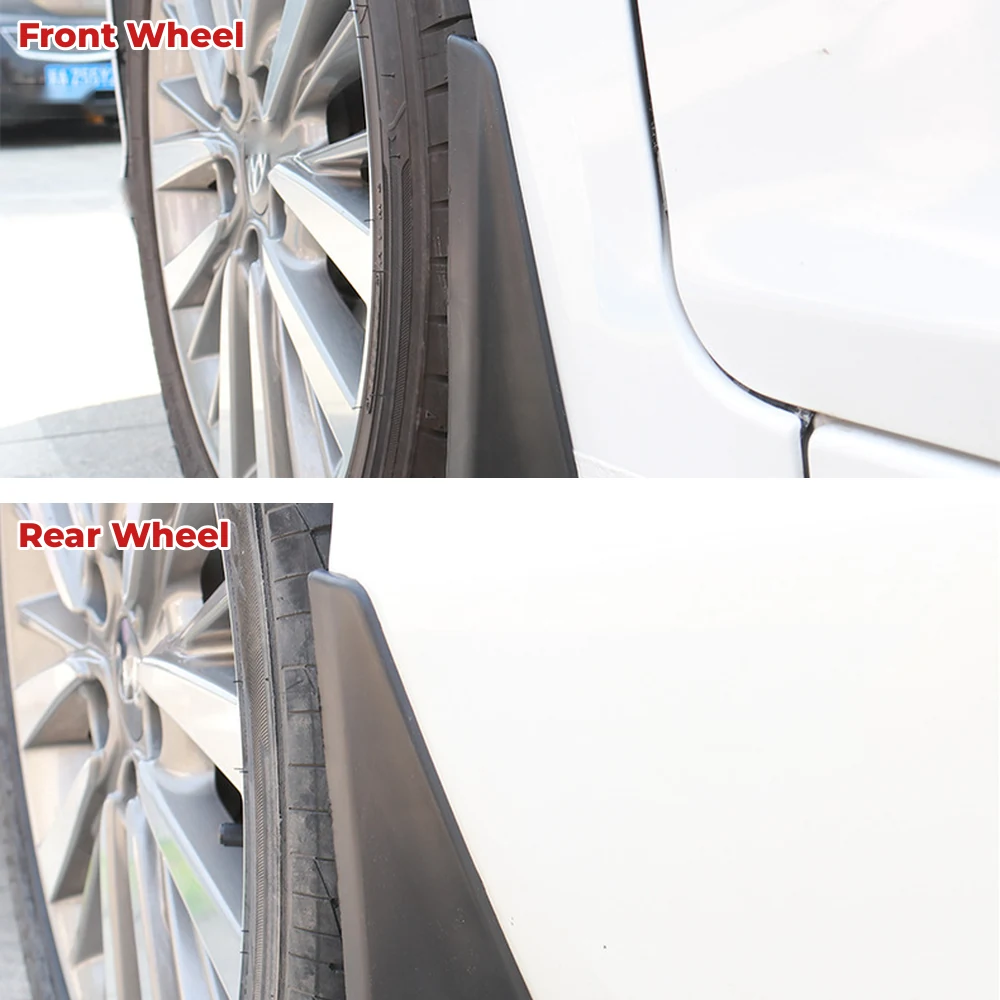
In Queensland’s Light Vehicle Inspection Manual (effective 7 July 2026), a mudguard is rejected if it is not capable of deflecting downwards mud, water, stones or other material thrown upward by the rotation of the wheels. A hanging accessory occupies part of that path behind the tyre. In Queensland’s Vehicle Standards and Safety Regulation, Schedule 1, the body can act as a mudguard, so that function statement is not a rule that every car must have an extra flap.
Tesla’s Model 3 instructions for 2017–2023 vehicles recommend splash guards, in that manufacturer’s terminology, if you drive on roads where salt, sand or gravel are commonly used to improve road conditions. That is a specific official recommendation for that accessory system. It is not a measurement of how much material a BYD hanging flap will stop, and it is not a rust warranty.
What you can observe on your own car
Look at the paint, cladding and sills immediately behind each wheel. If you already see stone peppering, a grit film or a salt stain in that zone, a flap is aimed at the path that material took from your own tyre. If those panels stay clean on the roads you actually use, the usefulness of an extra panel is smaller, and the decision may come down to appearance only.
A flap does not shield the rest of the car from stones thrown by other vehicles. It does not replace washing after driving on salted or muddy roads, and it is not a rust-proofing system. Intact coatings and drainage still matter.
When you may reasonably decide against a set
You may decide not to fit one if you do not want any panel hanging past the arch line, or if the car already has guards whose position and condition you are happy with. Those are preference and condition checks, not a judgement that the part does not work.
If you cannot yet match a kit to the vehicle, or if a parked view already shows the flap close to the tyre, or the wheels differ from stock, settle the fit and clearance question first. The usefulness of the part does not override a contact risk. Use the installation checks once you have a part that matches the mounting face.
A vehicle-specific set and a universal cut-to-fit blank fail in different ways if the outline or mounting points do not match the arch. See universal vs vehicle-specific mud flaps for how to check that fit.
If you have already decided flaps are worth fitting, the next step is matching a set to the car and reading the mount from the listing. See how to choose mud flaps that fit right.
Efficiency claims are not part of this decision
No trustworthy generic fuel-use or EV-range figure for passenger-car mud flaps is used here. A listing that promises an exact percentage is not evidence to plan around. Decide on the paint-and-spray job, the appearance you will accept, and whether the set can be fitted without fouling the tyre.
What to do next
If the usefulness check is positive, the next step is to match a kit to your car and read the mounting method and hardware on that listing. Send photographs of the arch, and of any existing marks on the lower body, through the contact form if you want a seller to identify a matching set before you order.
Whether a hanging accessory is legally required where you drive is a separate question from whether it is useful on your roads.

 English
 Portuguese
 French
 Turkish
 Russian
 Arabic
 Spanish