
For years, the electric vehicle industry has been trapped by an “impossible triangle”: automakers had to choose between long range, high performance, and ultra-fast charging. You could rarely have all three without compromising safety or driving up costs. However, during its “Disruptive Technology” event on March 5, 2026, BYD claimed to have shattered this barrier with the introduction of the Blade Battery 2.0.
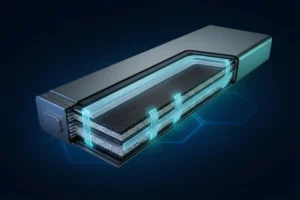
This second-generation power unit represents a significant leap forward in battery chemistry and structural engineering. By moving beyond traditional Lithium Iron Phosphate (LFP) and introducing new materials, BYD has achieved a battery capable of 10C charging rates, a lifespan of over 3,300 cycles, and enough energy density to push flagship sedans past the 1,000-kilometer range mark .
Here is a deep dive into the science, engineering, and real-world implications of BYD’s Blade Battery 2.0.
What’s New in the Second-Generation Blade Battery
The original Blade Battery, launched in 2020, revolutionized the industry by proving that LFP chemistry could be packaged densely enough to compete with Nickel Manganese Cobalt (NMC) batteries, all while offering superior safety. The Blade Battery 2.0 builds on this legacy but fundamentally changes the recipe.
The most critical upgrade is the shift from standard LFP to Lithium Manganese Iron Phosphate (LMFP) for the cathode. By adding manganese to the chemical mix, BYD has increased the battery’s operating voltage from 3.2V to 3.8V. This higher voltage directly translates to higher energy capacity without requiring a larger physical footprint .
Furthermore, BYD has integrated a silicon-carbon anode. Traditional graphite anodes have reached their theoretical limits for energy storage. Silicon can hold significantly more lithium ions than graphite, but it historically suffered from expansion and contraction issues during charging, which degraded the battery quickly. BYD’s engineering team has solved this by utilizing high-throughput electrode restructuring and aligning graphite particles perpendicular to the electrode plane, creating a stable matrix for the silicon .
The result is a cell-level energy density of 190 to 210 Wh/kg, a roughly 30% to 40% improvement over the first generation’s ~150 Wh/kg .
| Specification | Blade Battery 1.0 (LFP) | Blade Battery 2.0 (LMFP + Si-C) |
| Cathode Chemistry | Lithium Iron Phosphate | Lithium Manganese Iron Phosphate |
| Anode Material | Graphite | Silicon-Carbon |
| Cell Energy Density | ~150 Wh/kg | 190 – 210 Wh/kg |
| Max Charging Rate | 2C – 3C | Up to 10C |
| Cycle Life | ~3,000 cycles | 3,300+ cycles |
Short Blade vs. Long Blade: Two Distinct Formats
Unlike the first generation, BYD has bifurcated the Blade Battery 2.0 into two distinct physical formats to address different vehicle requirements .
The Short Blade 2.0 (measuring 450–580 mm) is the high-power specialist. It is engineered specifically to support extreme charging speeds, boasting an 8C to 10C peak charge rate and a 16C peak discharge rate. This variant is primarily intended for performance-oriented 800V–1000V platforms and high-end plug-in hybrid electric vehicles (PHEVs).
The Long Blade 2.0 (measuring 960 mm) is the high-energy specialist. It focuses on maximizing energy density to achieve the longest possible range. While its charging rate is slightly lower (around 3C), it achieves the maximum 210 Wh/kg energy density, making it ideal for flagship long-range battery electric vehicles (BEVs) .
The Physics of 10C Charging — And Why It Usually Destroys Batteries
In battery terminology, the “C-rate” measures how fast a battery is charged or discharged relative to its maximum capacity. A 1C rate means the battery charges from 0 to 100% in one hour. Therefore, a 10C charging rate implies the battery can theoretically accept a full charge in just six minutes.
Historically, pushing a battery to 10C was a recipe for disaster. Ultra-fast charging forces lithium ions to move rapidly from the cathode to the anode. If they move too fast, they cannot intercalate (embed) into the anode properly. Instead, they pile up on the surface, forming metallic lithium—a process known as lithium plating. This not only permanently reduces the battery’s capacity but can also create dendrites (microscopic spikes) that pierce the battery separator, leading to short circuits and fires.
To prevent this, BYD developed a breakthrough Solid Electrolyte Interphase (SEI) layer. The SEI is a protective film that forms on the anode. BYD’s new SEI uses molecular-level engineering to be ultra-thin, allowing for high ionic conductivity, yet highly dense to ensure chemical stability. Crucially, it features dynamic self-repairing technology, maintaining its integrity even under the extreme stress of 10C charging .
FlashPass Ion-Transfer System
To facilitate this massive influx of energy without overheating, BYD introduced the ‘FlashPass’ Ion Transport System. This system is built on three core innovations:
1.’Flash-Release’ Cathode: Features a directionally engineered, multi-level particle-size architecture that enables dense packing and rapid deintercalation of lithium ions.
2.’Flash-Flow’ Electrolyte: Utilizes AI-driven precision optimization to deliver high ionic conductivity and fast ion mobility through the liquid medium.
3.’Flash-Intercalate’ Anode: Boasts a multi-dimensional lithium-insertion site construction, allowing 360° 3D high-speed lithium-ion intercalation .
Together, these technologies reduce the battery’s internal resistance by 50%. Lower resistance means less energy is wasted as heat during charging, which is the primary bottleneck for sustained fast charging speeds .
Real-World Range — What 1,000+ km Actually Means
The combination of LMFP chemistry and the silicon-carbon anode allows BYD to pack more energy into the same physical space. This has profound implications for vehicle range.
The first vehicles to feature the Blade Battery 2.0 are the premium Yangwang U7 and the Denza Z9 GT. Under the Chinese Light-Duty Vehicle Test Cycle (CLTC), the Yangwang U7 achieves a staggering 1,006 km of range, while the Denza Z9 GT reaches 1,036 km .
It is important to note that the CLTC standard is generally more optimistic than the European WLTP or the American EPA standards. However, even applying a conservative 25% reduction to estimate real-world highway driving, these vehicles will comfortably exceed 700 to 750 kilometers (approx. 435 to 465 miles) on a single charge. This effectively eliminates range anxiety for the vast majority of drivers, making electric vehicles viable for long-distance road trips without frequent stops.
Safety First — How BYD Validates the Battery
BYD built its reputation on the safety of the original Blade Battery, famously demonstrating its resilience by driving a nail through it without causing a fire. The Blade Battery 2.0 maintains and exceeds these rigorous standards.
During the March 2026 launch, BYD showcased the battery passing China’s strict GB 38031-2025 standard. This included a 400 kN compression test and a 70 km/h underbody scraping test, all while maintaining its no-fire, no-explosion performance . Furthermore, the battery passed a forced short-circuit test involving four cells simultaneously, withstanding internal temperatures exceeding 700°C without exploding.
The battery also utilizes CTB 2.0 (Cell-to-Body) integration. By making the battery pack a structural component of the vehicle chassis, BYD increases volumetric space utilization to 76% while significantly improving the vehicle’s torsional rigidity and crash safety .
Cold Weather Performance
One of the most significant drawbacks of current EV batteries is their poor performance in freezing temperatures. Cold weather slows down the chemical reactions inside the battery, drastically reducing both range and charging speed.
The Blade Battery 2.0 addresses this through its advanced electrolyte and internal thermal management. Even at a punishing -30°C (-22°F), the battery can charge from 20% to 97% in just 12 minutes . Furthermore, capacity retention at -20°C remains above 85% . This makes EVs equipped with this technology highly practical for consumers in Northern Europe, Canada, and the northern United States.
Which BYD Models Get Blade Battery 2.0 First
The rollout of the Blade Battery 2.0 will begin with BYD’s premium brands before cascading down to mainstream models. The initial lineup includes:
•Yangwang U7: The ultra-luxury performance sedan, priced around 1.09 million yuan ($150,760), featuring the Long Blade for maximum range .
•Denza Z9 GT: The flagship shooting-brake grand tourer, leading the European rollout.
•Han L and Tang L: The next generation of BYD’s flagship sedan and SUV, built on the new Super e-Platform .
By scaling production rapidly, BYD aims to democratize this technology, eventually bringing high energy density and fast charging to vehicles across its Ocean and Dynasty series by late 2026.
FAQ
Q: What is the difference between LFP and LMFP batteries?
A: LMFP (Lithium Manganese Iron Phosphate) adds manganese to the traditional LFP (Lithium Iron Phosphate) chemistry. This increases the battery’s operating voltage from 3.2V to 3.8V, resulting in a higher energy density (more range) while maintaining the safety and cost-effectiveness of LFP.
Q: How fast can the Blade Battery 2.0 charge?
A: Under optimal conditions using a compatible 1,500 kW charger, the Short Blade variant of the Blade Battery 2.0 can charge from 10% to 70% in just 5 minutes, and from 10% to 97% in 9 minutes.
Q: Will the Blade Battery 2.0 degrade faster because of 10C charging?
A: No. BYD has engineered an ultra-thin, self-repairing Solid Electrolyte Interphase (SEI) layer and reduced internal resistance by 50% to prevent lithium plating and heat damage. The battery is rated for over 3,300 cycles (approx. 1.5 million km).
Q: Does the 1,000 km range apply to all BYD cars now?
A: No, the 1,000+ km range (CLTC) is currently achieved on flagship aerodynamic models like the Yangwang U7 and Denza Z9 GT equipped with the 120 kWh Long Blade battery packs. However, all models using Blade Battery 2.0 will see a proportional increase in range.
Q: Can I charge a Blade Battery 2.0 on a standard public charger?
A: Yes. While you need a BYD Megawatt Flash Charger to achieve the 5-minute charge times, the vehicle is fully compatible with standard CCS public fast chargers and home AC chargers.

 English
 Portuguese
 French
 Turkish
 Russian
 Arabic
 Spanish