

Planning a weekend family outing—or simply managing daily routines like school drop-offs and grocery runs—often brings up the same dilemma for many households: what kind of vehicle actually fits family life? It needs to swallow luggage and everyday clutter with ease, keep everyone comfortable, and still feel like it has character—something more than a plain “tool for getting around.”

That’s exactly why the Fangchengbao Titanium 7 caught my attention when I first encountered it at an auto show. On the surface, it looked like it could solve many of the real-world pain points families face. After spending meaningful time driving and living with the Titanium 7, the impression becomes clearer: it behaves less like a conventional mid-to-large SUV and more like a partner that understands family needs—handling daily commuting, longer highway trips, and everything in between with reassuring competence.
Comfort You Notice Immediately
The first thing you feel from the driver’s seat is the Titanium 7’s deliberate focus on ride comfort. Its suspension setup—a front double-wishbone and rear five-link independent suspension—is a solid, confidence-inspiring configuration for its class. More importantly, it is paired with DiSus-C intelligent damping body control and an active preview function, which together provide a noticeable improvement in ride quality.
This system uses a camera to identify bumps and surface changes ahead, then proactively adjusts suspension damping before the vehicle reaches them. In real driving, taking a speed bump at around 40 km/h, the body stays composed and stable. The impact that reaches the cabin is softened rather than sharp, and passengers in the rear row don’t experience the kind of jolt that usually leads to complaints on family trips. On fast highway curves, the suspension shifts its character—offering stronger support and reducing body roll, which makes the vehicle feel calmer and more secure at speed.
What may surprise many drivers is that despite its substantial size, the Titanium 7 remains easy to place in the city. With a turning radius of approximately 5.67 meters, it feels agile during U-turns and when searching for parking, holding its own against smaller vehicles and making everyday urban commuting far more convenient than you might expect.
A “Large Five-Seat” Cabin That Uses Space Wisely
For family users, cabin space is not a marketing point—it directly shapes the travel experience. Here, the Titanium 7 performs strongly. With a body length close to five meters and a 2,920 mm wheelbase, it commits fully to a “large five-seat” layout, prioritizing space utilization over squeezing in an occasional third row.
At 180 cm tall, I found rear-seat legroom generous, with more than two fists of clearance between my knees and the front seatbacks. Headroom is also ample, avoiding any cramped feeling. Even taller passengers can maintain a relaxed posture without needing to compromise on seating position.


Seat comfort is another highlight. The Titanium 7 comes standard with leather “soufflé” seats, which are softly padded yet provide good support. The front passenger seat includes an extra-large thigh support, offering meaningful support under the knees—something passengers notice most on longer journeys. Feedback from family members was consistent: legs felt less fatigued after extended driving. Both front and rear seats also include heating and ventilation, improving comfort across different seasons.
Storage That Matches Real Family Use
Passenger space is only part of the story. The Titanium 7’s storage design clearly anticipates how families actually travel.
The trunk’s standard capacity comfortably handles luggage for a family of three on a longer trip. Fold down the rear seats and you get an almost flat load floor with up to 1,880 liters of space—enough for bulky items like ski boards or folding bicycles without feeling like you’re playing a game of Tetris. On occasion, that expanded space can even serve as a reasonably comfortable area for a short rest.
Inside the cabin, the Titanium 7 offers 47 separate storage spaces, and the details are thoughtfully handled. The door pockets include a stabilizing structure so bottles don’t rattle or create noise on rougher roads. The rear center armrest adds dedicated cupholders and small compartments—useful for keeping children’s snacks and toys organized so the cabin stays tidy rather than chaotic.
There are also optional intelligent child safety seats and pet safety seats available. Notably, the system allows you to check the status of children or pets directly through the infotainment interface, which adds peace of mind when traveling with young passengers or animals.
Rugged “Boxy” Styling with a Refined Edge
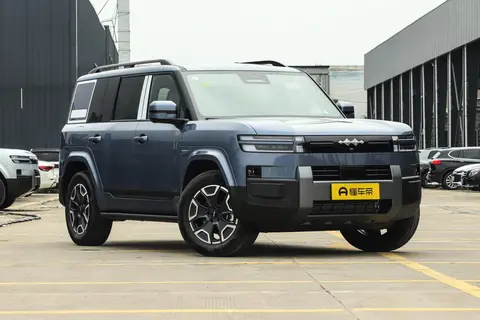
Design-wise, the Titanium 7 adopts a clear “boxy” silhouette, naturally reminiscent of classic off-road vehicles. The front end looks broad and confident, with raised hood lines that add muscularity. The double-layer L-shaped headlights are highly recognizable—and have earned the nickname “double-eyelid” lights among many users.
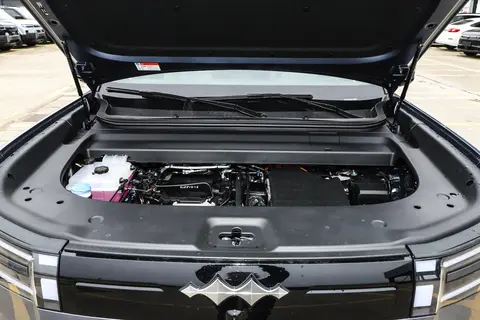
The side profile stays clean and geometric: straight lines, a floating roof, fixed side steps, and flared wheel arches that strengthen the tough, outdoors-ready stance. At the rear, a side-opening tailgate and an externally mounted utility box (often referred to as a “small backpack”) reinforce the adventure theme.
Importantly, the Titanium 7 doesn’t chase roughness for its own sake. Matte trim pieces in body color and tasteful chrome accents introduce a more refined impression. That balance matters: the vehicle looks appropriate not only on outdoor trips, but also in urban business settings or a family gathering parking lot—distinctive without being out of place.
A Cabin That Blends Toughness with Warmth
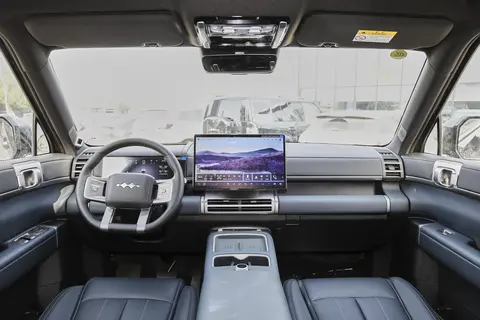
Open the door and the interior design echoes the exterior’s structured character. The cabin feels orderly and bold, but BYD softens the mood through a mix of square and rounded design elements, plus three interior color options: Snow Gray, Eclipse Blue, and Sunset Cloud Orange—a palette that adds a warmer, more home-like atmosphere.
The four-spoke multifunction steering wheel and column-mounted shifter bring a sense of ceremony to operation while freeing up more space in the center tunnel. That extra room becomes practical storage for everyday items such as phones, wallets, and keys.
Materials in high-contact areas—such as the upper dashboard and door panels—are largely finished in soft-touch surfaces. Some sections do use harder plastics, but the overall material strategy feels reasonable and durable for the segment.
The display layout creates a strong tech-forward atmosphere: a 12.3-inch full digital instrument cluster, a 15.6-inch floating central touchscreen, and a 27-inch W-HUD head-up display form a coordinated three-screen setup. The DiLink smart cockpit runs smoothly and supports 5G connectivity and four-zone voice recognition. In practice, that means drivers can use voice commands to control navigation, music, and climate functions—reducing distraction and keeping attention where it belongs.
Powertrain Choices That Match Different Lifestyles
Every Titanium 7 is equipped with a 1.5T engine, and buyers can choose between two drivetrains and different battery capacities to match real-world usage.
For drivers focused mainly on city commuting with occasional short suburban trips on weekends, the two-wheel-drive versions with 135 km or 200 km of pure electric range are a strong fit. These models use a 200 kW electric motor, which is more than sufficient for a mid-to-large SUV. Launch response at traffic lights is quick and smooth, and the official 0–100 km/h acceleration time ranges from 7.5 to 7.9 seconds, meeting everyday needs comfortably.
In pure EV mode, the article notes a running cost of about 0.1 RMB per kilometer, and while that currency figure is market-specific, the underlying point remains: operating costs can be meaningfully lower than comparable gasoline SUVs. Charging capability is also practical: the system supports 73 kW DC fast charging, with a stated theoretical charge window of 30% to 80% in about 30 minutes—enough to add useful range during a short break.
For drivers who want stronger performance or who occasionally venture onto unpaved surfaces for light off-road use, the four-wheel-drive version is better suited. It uses one motor on each axle, delivering a combined output of 360 kW and 620 N·m of total torque. Acceleration improves dramatically, with 0–100 km/h in just 4.5 seconds, which is especially valuable when overtaking large vehicles quickly and confidently.
This DM system supports full-speed wheel-end decoupling, allowing two-wheel-drive and four-wheel-drive modes to switch within 200 milliseconds. In practical terms, it means the vehicle can bring AWD traction online when needed, yet maintain two-wheel-drive efficiency during normal driving. Combined with a 60-liter fuel tank, the Titanium 7 achieves a total driving range of over 1,300 km, making long-distance travel—such as trips comparable to Beijing to Shanghai—possible without frequent energy stops.
Driver Assistance, Parking Support, and Safety Coverage
On intelligent driving, the Titanium 7 offers two versions of the “God’s Eye” driver assistance system. The top-spec Ultra version features lidar and supports driving assistance in urban road scenarios. Other versions use a triple-camera setup, focusing primarily on highway assistance, which helps reduce fatigue on long drives.
Users have reported that in city-road assistance scenarios, the system has successfully avoided sudden “ghost probe” incidents—situations where a pedestrian or obstacle unexpectedly emerges from a blind spot—highlighting real-world usefulness.
BYD has also made a notable commitment regarding parking assistance: if an accident occurs during use of the parking assist function, the company will provide full coverage, reducing user hesitation and building trust in the feature. The top version can also be equipped with the optional Lingyuan intelligent in-car drone system, offering more creative angles for travel photography and recording.
For passive and active safety, every Titanium 7 comes standard with nine airbags and TSC high-speed tire blowout assist stability control, providing a strong baseline of protection for family travel.
Choosing the Right Version for Your Needs
When it comes to choosing a configuration, the article highlights the 200 km two-wheel-drive Max version as a well-balanced option for most families who primarily drive in cities and on highways. Compared with the entry version, it increases pure electric range to 200 km and adds comfort-enhancing features such as adjustable suspension damping.
For buyers who prioritize stronger performance and a more comprehensive driver assistance package, the 190 km four-wheel-drive Ultra version stands out with its 4.5-second 0–100 km/h capability, richer driving assistance features, and a reportedly higher share of user selection.
A Well-Rounded SUV That Understands Family Priorities
Looking back on the time spent with the Fangchengbao Titanium 7, the vehicle’s appeal isn’t built on dominating one single metric. Instead, it achieves something many family buyers value more: balance. It blends personality, comfort, spaciousness, efficiency, and safety into one coherent package.
The rugged exterior answers the desire for individuality and an outdoor-ready image. The generous cabin, thoughtful comfort features, and extensive storage solve day-to-day family needs. And the combination of efficient energy use and comprehensive safety equipment helps reduce long-term ownership stress.
For families looking to upgrade their travel quality without compromising on design or lifestyle identity, the Titanium 7 is a vehicle worth experiencing in person—because its strengths are not just in specifications, but in how naturally it fits into real family life.


 English
 Portuguese
 French
 Turkish
 Russian
 Arabic
 Spanish