

As global demand for cleaner and more efficient mobility accelerates, hybrid technology has entered a new stage of innovation. Consumers expect vehicles to offer strong fuel economy, smooth driving performance, and long-term reliability without compromising power or comfort. In this landscape, BYD’s DM-i hybrid system has emerged as one of the most advanced solutions in the industry. Built under the company’s long-standing strategy of vertical integration, the DM-i system prioritizes electric-driven performance while retaining the practicality of a hybrid structure, enabling exceptional efficiency across a wide range of driving scenarios.

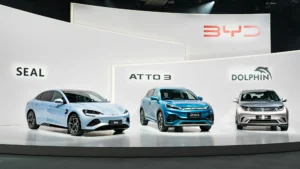
Since its introduction, DM-i has redefined the expectations for plug-in hybrid technology in the Chinese and global markets. The system is widely applied across BYD’s Dynasty and Ocean series—including the Qin Plus, Destroyer 05, Song Pro, Song Plus, Seal 06, Seal 07, and Sea Lion 05—ensuring consistent performance standards across sedans and SUVs. With continuous updates to the EHS electric hybrid module and the latest-gen blade battery, DM-i represents a maturing technical ecosystem rather than a single innovation.
1. A Hybrid System Designed Around Electric Drive
Unlike traditional hybrid systems that rely heavily on the internal combustion engine, DM-i operates on an “electric-first” architecture. The gasoline engine plays a supporting role, operating primarily as an efficient generator. Most urban and mid-speed driving scenarios are powered directly by the electric motor, enabling a smooth and quiet driving experience similar to that of a pure electric vehicle.

Core characteristics of the DM-i architecture include:
- Electric-dominant driving logic
The vehicle is driven by the traction motor in the majority of conditions, reducing dependence on mechanical engine output.
- High-efficiency Atkinson-cycle engine
BYD’s dedicated hybrid engine achieves a thermal efficiency of over 43%, placing it among the highest-performing hybrid engines in mass production.
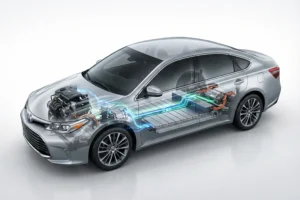
- EHS (Electric Hybrid System) integration
The motor, generator, and hybrid control unit are packaged into a compact, lightweight module, optimizing system efficiency and space utilization.
- High-voltage blade battery
The battery provides strong discharge capability and quick energy replenishment, supporting both electric cruising and hybrid transitions.
Through this structure, DM-i combines the range convenience of gasoline with the energy efficiency of electrification—making it highly suitable for regions where charging infrastructure is still developing.
2. Efficiency Gains Backed by Engineering Precision
One of the DM-i system’s defining strengths is its efficiency. The system focuses on minimizing energy waste through refined power distribution and intelligent control strategies.

Key factors contributing to DM-i efficiency include:
Optimized Engine Operating Points
The engine rarely drives the wheels directly at low speeds. Instead, it operates within its most efficient RPM range to generate electricity. This avoids inefficient engine conditions and significantly reduces fuel consumption.
Rapid Energy Recovery and Utilization
During deceleration and braking, the motor captures kinetic energy and stores it in the battery. The system’s high recovery rate ensures minimal loss during energy conversion.
High motor efficiency
The traction motor delivers strong torque at low RPM, allowing the vehicle to reach optimal acceleration with minimal energy expenditure.
Intelligent hybrid control strategy
DM-i seamlessly switches among EV mode, hybrid mode, and engine direct drive based on speed and load, ensuring the system remains in its most efficient state without noticeable transitions to the driver.
These engineering choices allow DM-i models to achieve fuel consumption figures dramatically lower than conventional gasoline vehicles, with many models reaching real-world averages below 4 L/100 km when the battery is depleted—a benchmark few competitors can match.
3. Blade Battery: Enhancing Hybrid Reliability and Energy Depth
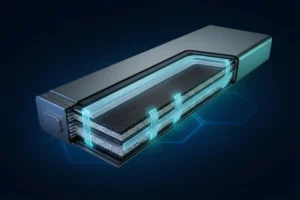
The DM-i system is supported by BYD’s proprietary blade battery, a long-cell LFP structure engineered for durability, safety, and high discharge efficiency. While the blade battery is well-known in pure electric models, its role in hybrids is equally critical.
Role of the blade battery within DM-i:
- Stable performance in rapid charge/discharge cycles essential for urban stop-and-go traffic
- High safety margin, with strong resistance to thermal runaway
- Long service life, making the hybrid system suitable for high-mileage users such as commuters and fleet operators
- Optimized energy density, enabling long electric-only driving ranges in the 55 km, 115 km, 150 km, 200 km, and 230 km variants
Because DM-i relies heavily on electric propulsion, battery quality directly affects driving refinement, energy efficiency, and long-term system stability. BYD’s vertical integration ensures consistent performance across all hybrid models.
4. Seamless Driving Dynamics Across Urban and Highway Scenarios
A key advantage of DM-i is its ability to provide EV-like smoothness in daily driving. In urban commuting, the vehicle remains in EV mode most of the time, delivering instant torque and quiet acceleration. The absence of frequent gear shifts further contributes to a refined driving feel.
On highways, the system intelligently transitions to engine direct drive when it becomes more efficient than pure electric propulsion. This mode enhances fuel economy at higher speeds and supports stable cruising without excessive battery discharge.
Drivers experience:
- Quick acceleration from standstill
- Smooth and silent driving in low-speed environments
- Low vibration due to reduced engine engagement
- Strong mid-range torque for overtaking
- Predictable, linear power delivery
This balance between electric comfort and hybrid endurance makes DM-i suitable for both dense city traffic and long-distance travel.

5. Built for Global Expansion and Market Adaptation
DM-i is a scalable platform designed to serve diverse markets. Its flexible battery options, modular EHS units, and adaptable engine calibration allow BYD to customize models for regions with different fuel grades, climate conditions, and infrastructure maturity.
This adaptability has contributed to DM-i’s rapid adoption in markets such as:
- Southeast Asia
- Middle East
- Latin America
- Europe (select PHEV markets)
With growing global demand for energy-efficient mobility, DM-i provides a compelling solution for governments and consumers seeking both environmental benefits and practical usability.
Conclusion: A New Benchmark for Hybrid Technology
BYD’s DM-i hybrid system represents a significant evolution in the plug-in hybrid segment. By prioritizing electric-driven performance, optimizing energy conversion efficiency, and integrating the blade battery into a tightly coordinated system, DM-i delivers a refined and economical driving experience that addresses real-world mobility needs.
As BYD continues to expand globally, the DM-i technology platform stands as a cornerstone of the brand’s commitment to accessible, efficient, and sustainable innovation—helping shape the future of hybrid mobility with a balance of engineering precision and user-centered performance.


 English
 Portuguese
 French
 Turkish
 Russian
 Arabic
 Spanish