

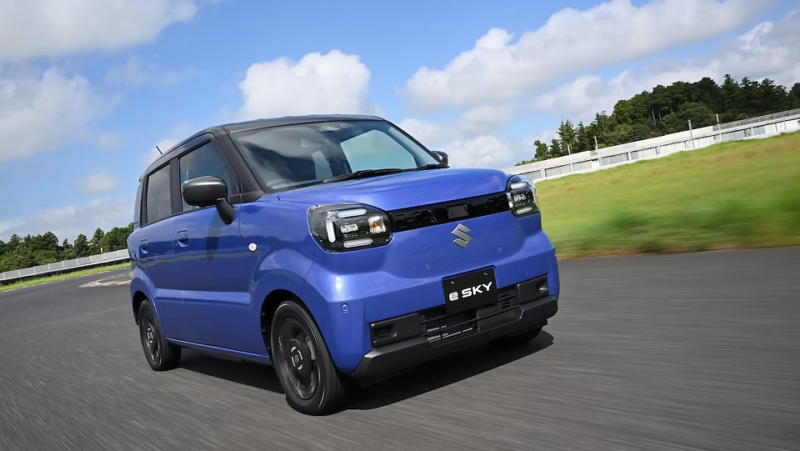
Suzuki has unveiled its first passenger kei-car EV, the e-Sky, and it relies on a Suzuki e-Sky BYD battery supply deal to reach a starting price of 2.12 million yen (13,400 USD). That figure makes the e-Sky the most affordable kei-car EV in Japan, undercutting both the BYD Racco and the long-established Nissan Sakura. The announcement, made on October 7, 2026, marks Suzuki’s formal entry into the electric vehicle segment after decades of dominating the Japanese kei-car market with petrol models. The e-Sky is built on a dedicated EV platform and features Suzuki’s proprietary e-Axle drive system. By partnering with BYD for the battery, Suzuki aims to undercut rivals and position the e-Sky as a price leader in Japan’s growing electric kei-car segment.
Suzuki e-Sky BYD Battery Partnership Drives Competitive Pricing
To achieve its aggressive price point, Suzuki collaborated with BYD, utilizing the Chinese giant’s lithium iron phosphate (LFP) battery technology. The e-Sky is powered by a 26 kWh LFP battery, delivering a WLTP range of 310 km. This partnership highlights BYD’s growing influence as a battery supplier to global automakers, even as it competes with them in the EV market. BYD’s LFP batteries are known for their cost-effectiveness and safety, making them an ideal choice for Suzuki’s budget-focused kei-car EV.
The collaboration also underscores the increasing interdependence of Japanese and Chinese automakers in the EV era, where scale and technology sharing are critical to reducing costs. For overseas buyers, this signals that BYD’s battery technology is gaining traction beyond its own vehicles, potentially opening new sourcing opportunities. BYD’s blade battery technology, which underpins many of its vehicles, is a key differentiator in terms of safety and longevity; you can learn more about it at BYD Blade Battery.
Suzuki e-Sky vs. BYD Racco: Range and Dimensions Compared
When compared to the entry-level BYD Racco, which has a 22.4 kWh LFP battery and a WLTC range of 210 km, the Suzuki e-Sky offers a longer range of 310 km (WLTP) despite its smaller battery. This difference is largely due to weight: the e-Sky weighs 1,030 kg, while the Racco weighs 1,160 kg with the 22.4 kWh battery and 1,220 kg or 1,230 kg with the larger 35.84 kWh version. In terms of dimensions, both vehicles share the same length (3,395 mm) and width (1,475 mm), but the e-Sky is lower at 1,625 mm compared to the Racco’s 1,800 mm. The e-Sky also has a shorter wheelbase of 2,460 mm versus the Racco’s 2,520 mm. These differences reflect distinct design priorities: the e-Sky focuses on efficiency and affordability, while the Racco offers more interior space.
Market Positioning and Pricing Strategy
Suzuki is offering the e-Sky in three versions. The entry-level model, designed primarily for corporate clients, is built-to-order and omits features like fast charging to keep costs low. Suzuki targets a combined monthly sales volume of 1,000 units across all three trims. With Japanese government subsidies of 568,000 yen (3,600 USD), the effective purchase price for consumers can drop to as low as 1.55 million yen (9,800 USD). This undercuts key rivals, including the BYD Racco (starting at 1.99 million yen after subsidies) and the Nissan Sakura (starting at 1.86 million yen after subsidies). Even without subsidies, the Suzuki e-Sky is still 20,000 yen (126 USD) cheaper than the BYD Racco, making it Japan’s cheapest kei-car EV. This pricing strategy could pressure competitors to adjust their own pricing or offer more features.
BYD’s Growing Presence in Japan’s EV Market
BYD has been making inroads into Japan with its Racco kei-car EV, which has sold 1,800 units since its July launch. The company plans to expand the Racco to Sri Lanka and Macao, indicating its ambition to export its kei-car EV to other right-hand-drive markets. Suzuki’s decision to use BYD’s battery for the e-Sky is a testament to BYD’s battery expertise and could pave the way for further collaborations. For overseas buyers interested in BYD’s EV lineup, including the Racco, exploring models and specifications is essential. You can find detailed information on BYD car models at BYD Car Models.
Implications for the Kei-Car EV Segment
Suzuki’s entry with the e-Sky intensifies competition in Japan’s kei-car EV segment, which is currently dominated by Nissan’s Sakura and Mitsubishi’s eK X EV. With its lower price and sufficient range, the e-Sky could attract price-sensitive consumers and fleet operators. In 2025, Suzuki sold 556,632 petrol-powered kei cars, demonstrating its strong brand loyalty and dealer network. Transitioning these customers to electric will be crucial for Japan’s carbon neutrality goals. The e-Sky’s success could also influence other Japanese automakers to accelerate their EV plans or seek partnerships with battery suppliers like BYD. For global markets, this collaboration highlights how Chinese battery technology is becoming integral to affordable EVs worldwide.
BYD’s Battery Supply Strategy and Global Implications
The Suzuki e-Sky BYD battery deal is more than a single supply contract; it reflects a broader strategic shift in the global auto industry. BYD has evolved from a pure automaker into a major battery supplier, competing with the likes of CATL, LG Energy Solution, and Panasonic. Its LFP batteries, particularly the blade battery, are prized for their high safety standards, long cycle life, and lower cost compared to nickel-manganese-cobalt (NMC) chemistries. For Suzuki, sourcing from BYD allows it to bypass the expensive and time-consuming development of its own battery technology, accelerating its time to market while keeping the e-Sky’s price competitive.
This partnership also signals a new dynamic in Japan-China automotive relations. Japanese automakers have traditionally been cautious about Chinese suppliers, but the relentless pressure to cut EV costs is forcing a rethink. Suzuki’s move could encourage other Japanese brands to explore similar collaborations, especially for entry-level EVs where price sensitivity is highest. For overseas buyers and importers, this trend is significant: it validates BYD’s battery technology on a global stage and may lead to more BYD-powered vehicles from non-Chinese brands. In turn, that could expand the availability of affordable EVs in right-hand-drive markets and beyond.
What to Watch Next
Keep an eye on the Suzuki e-Sky’s sales performance after its launch, particularly whether it meets the 1,000-unit monthly target. Also watch for BYD’s response, as it may adjust Racco pricing or introduce new features to maintain competitiveness. The expansion of BYD’s Racco to Sri Lanka and Macao will provide insights into the global appeal of kei-car EVs. Finally, any further collaborations between Suzuki and BYD could signal a deeper strategic alliance, potentially affecting the broader EV supply chain.
I’m Lucian from BYD Sourcing. With more than 10 years in the automotive industry and hands-on experience with export procedures and customs clearance, I help overseas buyers source Chinese EVs – especially BYD models – through official, verified channels, for both retail and wholesale. Contact us for a competitive quote.


 English
 Portuguese
 French
 Turkish
 Russian
 Arabic
 Spanish