

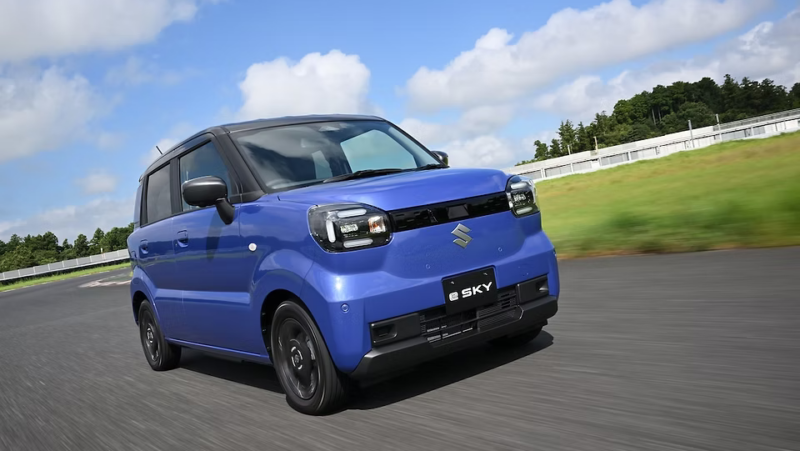
Suzuki utilizes a BYD battery to make its new e-Sky the most affordable kei-car EV in Japan. The model starts at 2.12 million yen (13,400 USD), marking Suzuki’s formal entry into the electric vehicle segment and a surprising strategic alliance with the Chinese battery giant. The e-Sky is built on a dedicated EV platform and features a 26 kWh lithium iron phosphate (LFP) battery supplied by BYD, delivering a WLTP range of 310 km. This collaboration allows Suzuki to leverage BYD’s cost-effective battery technology while maintaining its dominance in the Japanese kei-car market. With government subsidies, the effective price can drop to 1.55 million yen (9,800 USD), undercutting key rivals and reshaping the affordable EV landscape in Japan.
Strategic Pricing and the BYD Collaboration
Suzuki’s partnership with BYD is central to the e-Sky’s competitive pricing. By using BYD’s LFP battery technology, Suzuki achieves a starting price of 2.12 million yen (13,400 USD), making it the most affordable kei-car EV in Japan. The e-Sky is powered by a 26 kWh LFP battery, which provides a WLTP range of 310 km. In comparison, the entry-level BYD Racco, with a 22.4 kWh LFP battery, offers a WLTC range of 210 km, while higher-spec models feature a 35.84 kWh LFP battery and a WLTC range of 320 km. The range difference between the two cars is due to their different weights. The Suzuki e-Sky weighs 1,030 kg, while the Racco weighs 1,160 kg with a 22.4 kWh battery and 1,220 kg or 1,230 kg with the 35.84 kWh version.
The e-Sky’s efficiency advantage stems from its lighter curb weight, which is a direct result of Suzuki’s kei-car engineering philosophy. Kei cars are restricted by Japanese regulations to a maximum length of 3.4 meters, width of 1.48 meters, and engine displacement of 660 cc for gasoline models. For EVs, the rules focus on physical dimensions and power output. Suzuki’s decision to source batteries from BYD rather than developing its own cells in-house is a pragmatic move that speeds up development and reduces costs. BYD’s LFP batteries are known for their safety, longevity, and cost-effectiveness, making them attractive for various EV applications. This is not the first time BYD has supplied batteries to other automakers, but it is one of the most high-profile deals in Japan’s home market, where domestic brands have traditionally relied on local suppliers like Panasonic and GS Yuasa.
Market Positioning and Pricing Strategy
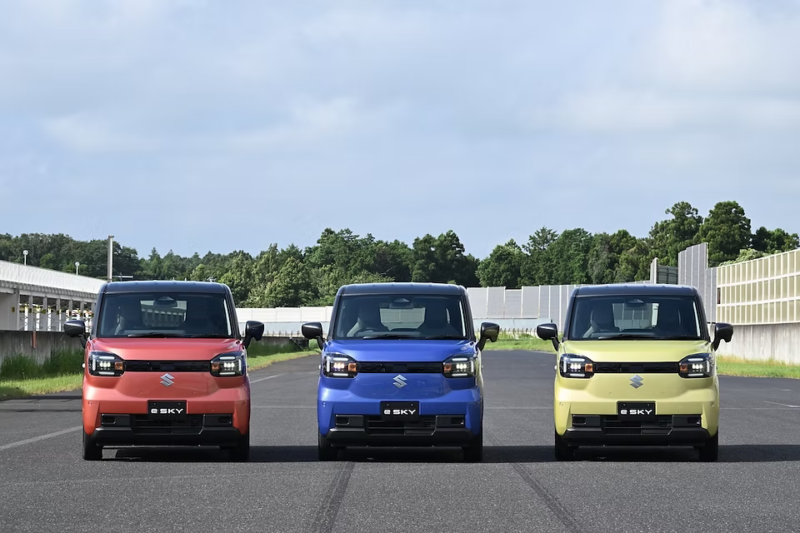
Suzuki is offering three versions of the e-Sky. The entry-level model, designed primarily for corporate clients, is built-to-order and omits features like fast charging to keep costs low. Suzuki aims for a combined monthly sales volume of 1,000 units across all three trims. With Japanese government subsidies of 568,000 yen (3,600 USD), the effective purchase price for consumers can drop to as low as 1.55 million yen (9,800 USD). This undercuts key rivals, including the BYD Racco (starting at 1.99 million yen after subsidies) and the Nissan Sakura (starting at 1.86 million yen after subsidies). Even without subsidies, the Suzuki e-Sky is still 20,000 yen (126 USD) cheaper than the BYD Racco, making it Japan’s cheapest kei car EV.
The pricing strategy is aggressive and signals Suzuki’s intent to defend its home turf against incoming Chinese competition. The BYD Racco, which launched in July, has already sold 1,800 units in Japan, proving that Chinese EVs can gain traction in a market known for brand loyalty. By undercutting the Racco on price while offering a longer WLTP range, Suzuki is directly challenging BYD’s value proposition. However, the two companies are also partners in this venture, creating a complex dynamic where BYD supplies the battery for a car that competes with its own vehicle. This kind of collaboration is becoming more common as automakers seek to share the massive costs of EV development.
Suzuki e-Sky vs. BYD Racco: Specifications
The Suzuki e-Sky and BYD Racco share similar dimensions but differ in height and wheelbase. The e-Sky measures 3,395 mm in length, 1,475 mm in width, and 1,625 mm in height, with a wheelbase of 2,460 mm. The Racco measures 3,395 mm long, 1,475 mm wide, and 1,800 mm high, with a wheelbase of 2,520 mm. The BYD Racco is bigger than the Suzuki e-Sky, particularly in height and wheelbase, which contributes to its higher weight and different range characteristics. Both vehicles target the kei-car segment, but Suzuki’s lighter weight and BYD’s battery technology give the e-Sky a distinct advantage in affordability and efficiency.
The height difference is striking: the Racco is 175 mm taller, which likely translates to more interior headroom but also a higher center of gravity. The longer wheelbase of the Racco (60 mm more) typically improves rear-seat legroom and ride stability, but it also adds weight. Suzuki’s decision to keep the e-Sky lower and lighter aligns with its traditional kei-car formula of maximizing interior space within minimal exterior dimensions. For urban driving, the e-Sky’s smaller footprint and lighter weight should make it more agile and efficient, while the Racco may appeal to buyers who prioritize interior space and a more SUV-like stance.
BYD’s Growing Influence in Japan’s EV Market
BYD’s battery supply to Suzuki underscores the Chinese automaker’s expanding role in Japan’s EV market. Since its July launch, the BYD Racco has sold 1,800 units, and the company plans to enter the Sri Lankan and Macao markets. In 2025, Suzuki sold 556,632 petrol-powered kei cars, highlighting its strong position in the segment. By collaborating with BYD, Suzuki can leverage BYD’s expertise in LFP batteries to accelerate its electric transition. This partnership also signals a broader trend of Japanese automakers sourcing batteries from Chinese suppliers to remain competitive. For more on BYD’s battery technology, see BYD Blade Battery.
BYD’s rise in Japan is notable because the Japanese market has historically been difficult for foreign automakers to penetrate. BYD’s strategy of offering affordable EVs with long warranties and competitive pricing has started to pay off. The Racco’s 1,800 sales since July may seem modest by global standards, but in the kei-car segment, where total monthly sales can be in the tens of thousands, it represents a meaningful beachhead. Suzuki’s decision to use BYD batteries is both a recognition of BYD’s technological prowess and a defensive move to keep its own EV prices low. If the e-Sky succeeds, it could encourage other Japanese automakers to follow suit, further integrating Chinese battery supply chains into the Japanese automotive industry.
Implications for Overseas Buyers and Exporters
The launch of the Suzuki e-Sky with BYD’s battery highlights the growing global demand for affordable EVs and the critical role of Chinese battery suppliers. For overseas buyers and exporters, this development presents opportunities to source BYD models and components through verified channels. BYD’s LFP batteries are known for their safety, longevity, and cost-effectiveness, making them attractive for various EV applications. As BYD expands its presence in Japan and beyond, buyers can explore a range of BYD car models suitable for different markets. The e-Sky’s success could further validate BYD’s battery technology and encourage more partnerships.
Exporters should note that the e-Sky is currently a Japan-only model, but the battery technology inside it is available in various BYD vehicles that are exported globally. The fact that Suzuki, a brand known for its conservative approach to electrification, chose BYD as a supplier is a strong endorsement. It suggests that BYD’s LFP batteries meet the rigorous quality and durability standards required by Japanese automakers. For buyers looking to source EVs from China, this partnership reinforces the reliability of BYD’s supply chain and its ability to work with international partners.
What to Watch Next
Watch for Suzuki’s e-Sky sales performance against the BYD Racco and Nissan Sakura in Japan. BYD’s planned expansion into Sri Lanka and Macao may indicate broader export strategies. Also, monitor whether other Japanese automakers follow Suzuki’s lead in adopting BYD batteries. These moves could reshape the affordable EV landscape and create new sourcing opportunities.
Another key metric will be whether Suzuki can meet its monthly sales target of 1,000 units for the e-Sky. If it does, it would validate the strategy of using a Chinese battery to lower costs. If it struggles, it could signal that Japanese consumers are not yet ready to embrace EVs from domestic brands that rely on foreign technology. The competitive dynamics between Suzuki and BYD will be fascinating to watch, especially since they are simultaneously partners and rivals.
I’m Lucian from BYD Sourcing. With more than 10 years in the automotive industry and hands-on experience with export procedures and customs clearance, I help overseas buyers source Chinese EVs – especially BYD models – through official, verified channels, for both retail and wholesale. Contact us for a competitive quote.

 English
 Portuguese
 French
 Turkish
 Russian
 Arabic
 Spanish