

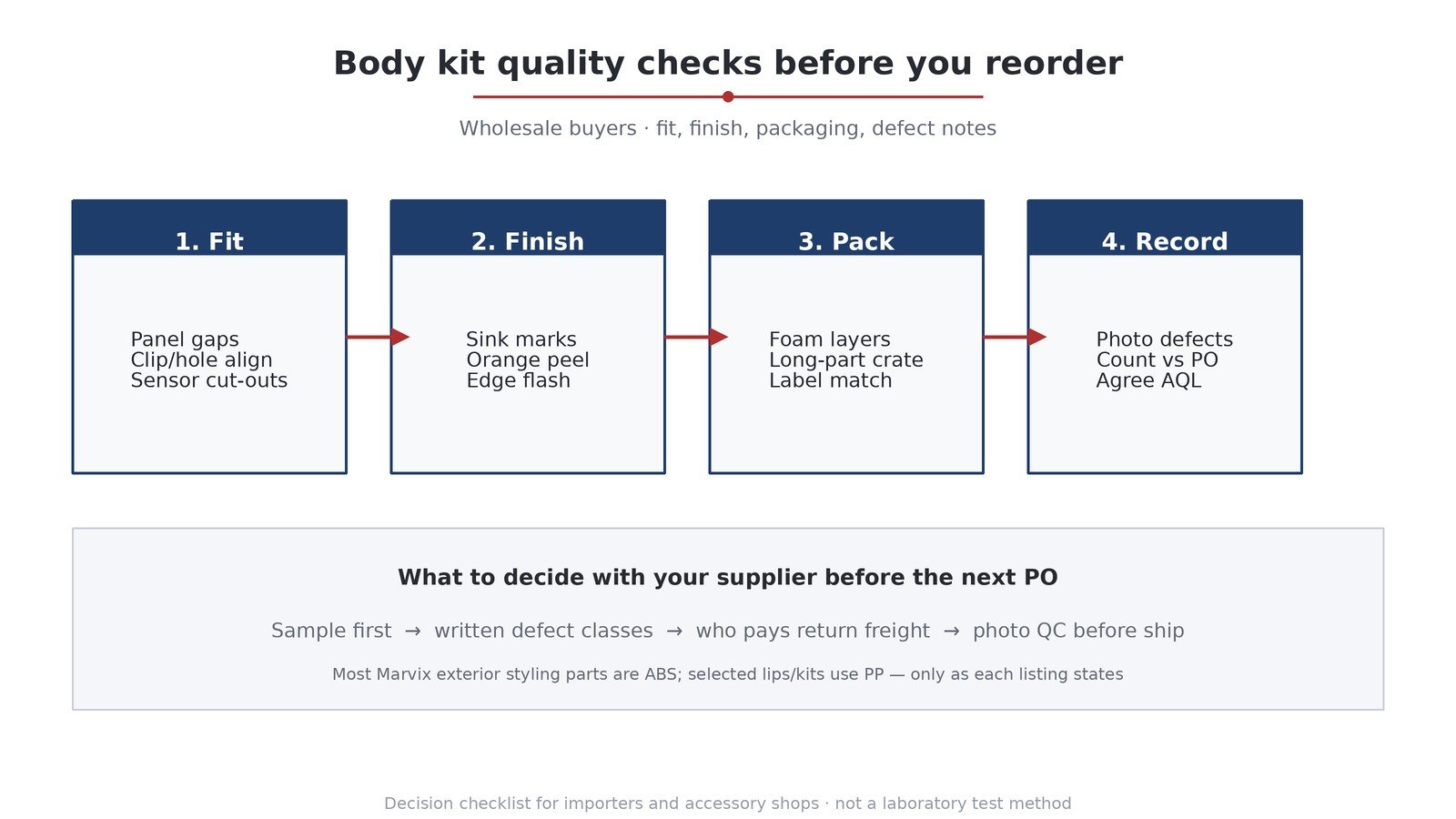
Body kit quality for wholesale buyers comes down to four checks before you reorder: fit on the correct BYD bumper line, surface finish you can photograph, packaging that survives a long carton, and a written way to count defects. Price alone does not tell you whether the next pallet will match the sample you approved.
This checklist is for importers, accessory shops and online stores that already know how to shortlist a supplier. It focuses on what to inspect on arrival and what to agree in writing before the next purchase order — not on marketing claims.
Why plastic body-kit quality is different from metal parts
Most exterior styling parts are injection-moulded plastics. Heat, gate position and cooling inside the mould affect sink marks, warp and how cleanly a clip tower forms. After moulding, parts may be trimmed, sanded at the parting line, then left as raw/primer plastic or finished in gloss black or paint.
That process means two cartons from the same tool can still differ if packing crushed a long skirt or if a batch left the line with more flash on the edges. Your incoming inspection has to look at geometry and surface, not only whether the SKU label matches the PO.
Most Marvix exterior styling parts are ABS, with PP on selected kits and lips; frunk storage boxes are typically PP or ABS as each product page states. Only name a material for a SKU when that listing states it. For a materials overview, see PP vs ABS vs fiberglass vs carbon fibre body kits.
1. Fit: what to check on the car or a body shell
Fit is the first reject reason for bumper lips, side skirts, diffusers and spoilers. On a sample car or a known-good body shell, walk this list:
- Panel gap and step along the bumper or sill — look for uneven reveal or a corner that stands proud.
- Clip and hole alignment against the factory mounting points the product page claims to use; do not force a clip that needs the hole opened out.
- Sensor and camera cut-outs — parking sensors, washers and reverse cameras must sit flush where the design includes openings.
- Drive side and market bumper — LHD and RHD under-bonnet layouts differ on some storage parts; bumper skins can also differ by facelift. Match photos to the listing rather than the China marketing name alone.
If you cannot trial-fit every inbound carton, at least trial-fit the first piece of each new mould revision and keep photo notes. For how sensors and cameras interact with kits, see do body kits affect EV range, parking sensors and ADAS cameras?.
2. Finish: gloss, primer and defects you can photograph
Finish rejects are easier to argue when you photograph them in daylight against a neutral background:
- Sink marks and witness lines on large flat areas (diffuser centres, skirt faces).
- Orange peel or dry spray on painted or gloss-black faces.
- Edge flash and gate nubs that were not trimmed clean.
- Colour mismatch between left and right parts in the same kit.
- Stress whitening near clips from packing or over-flex during install.
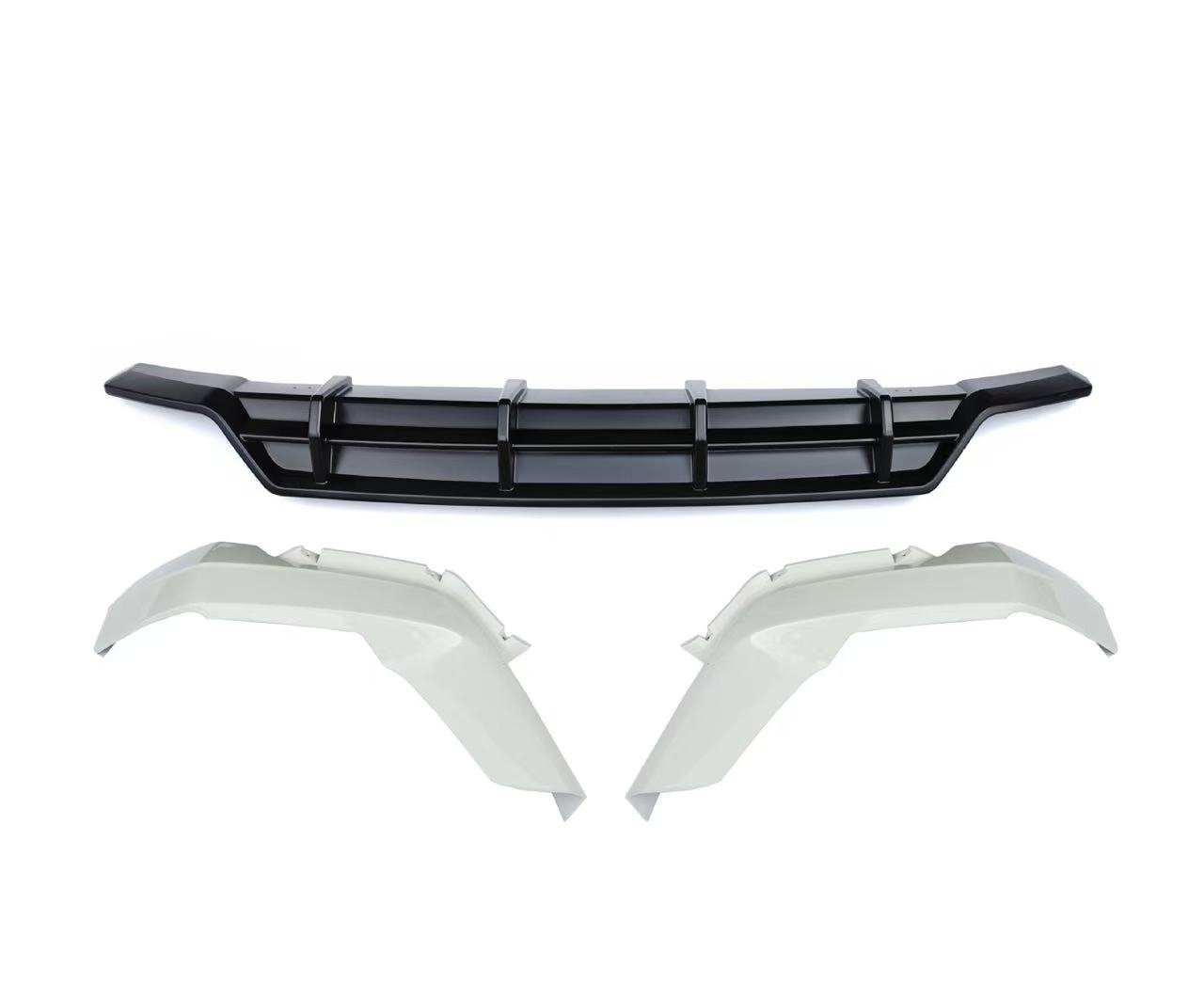
Raw or primer parts need a different standard: you are judging mould quality and sanding prep, not showroom gloss. Gloss-black “ready to fit” parts need a higher cosmetic bar because many customers will not paint them. For prep context on unpainted versus gloss parts, start from what a car body kit is and the material notes on each product page.
3. Packaging: long parts fail in the carton, not on the tool
Side skirts and full-width lips are long and thin. A mould can be fine and the part still arrives twisted if foam layers shifted or the carton took a corner hit. Check:
- Foam or film layers between painted faces.
- Wooden-frame or reinforced cartons for oversized pieces.
- Part count vs packing list — clips, badges and small end-caps go missing more often than main panels.
- Label match to the SKU you sell, including model name as buyers search it.
Agree who photographs the open carton on arrival for damage claims. For volumetric weight and lane terms, see how body kits are shipped internationally and the wider sourcing checklist in how to source BYD body kits from China.
4. Defect rates: agree classes before you argue about percentages
“Defect rate” only helps when both sides use the same classes. A practical wholesale approach:
- Define critical / major / minor — e.g. crack or wrong SKU = critical; visible sink on a gloss face = major; light flash on a hidden edge = minor.
- Set an inspection sample for each inbound shipment (every piece on the first PO, then a fixed sample on repeats).
- Record with photos and carton IDs so a claim can point to a specific part.
- Agree remedy — replacement, credit, or partial refund — and who pays return freight on critical defects.
Do not rely on a single percentage promised in chat. Put the classes and sample size on the PO or a short QC annex. Photo QC before the goods leave China is worth requesting on higher-value kits.
A simple wholesale QC workflow
- Order a 1-piece sample (or one full kit) and trial-fit on a known car.
- Photograph fit and finish; write pass/fail notes against the classes above.
- Lock the SKU photos and model naming on your store before the bulk PO.
- On arrival, count parts, open enough cartons to hit your sample size, and file defect photos the same day.
- Only then confirm the next reorder quantity and any packing changes.
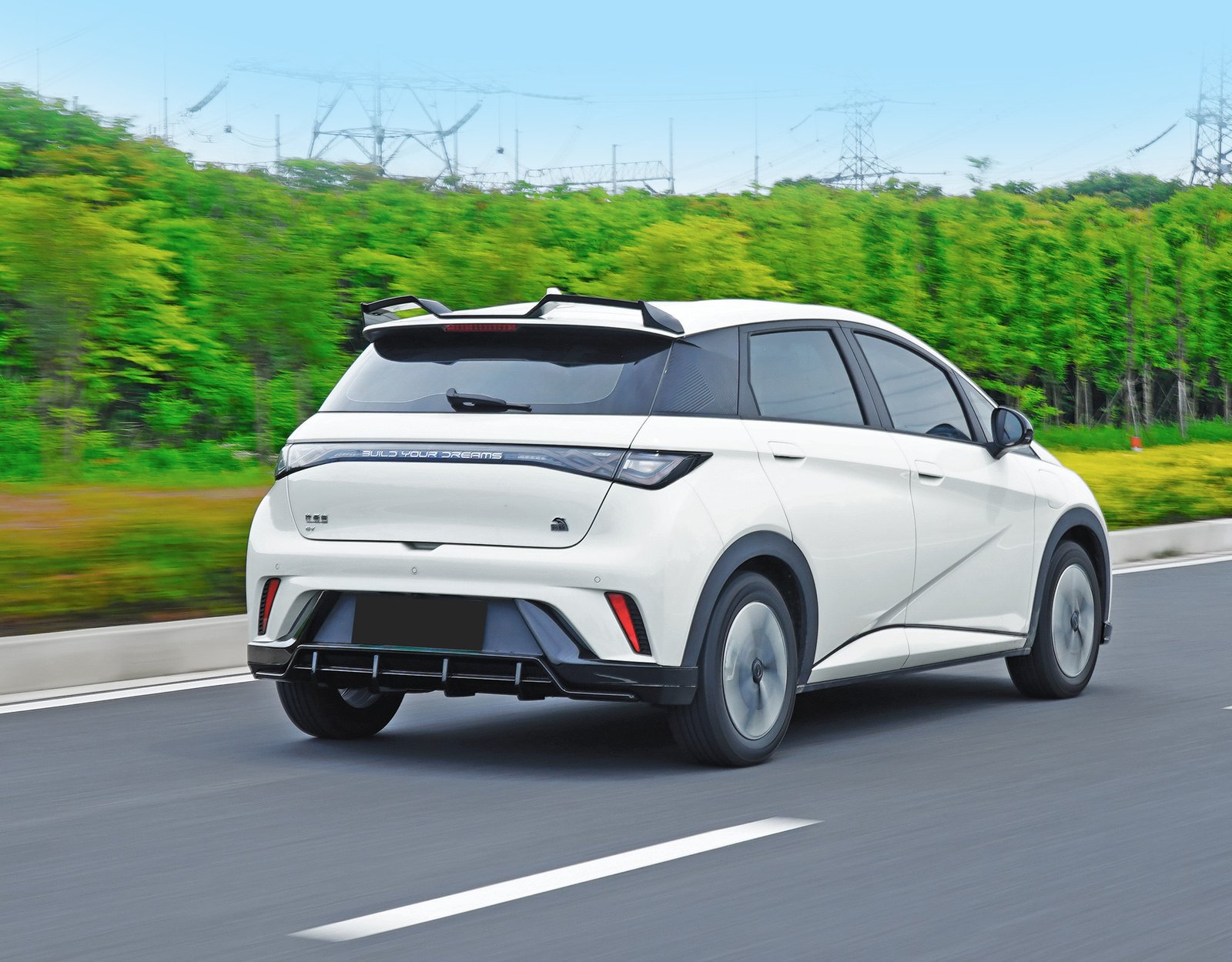
Browse live ranges under BYD body kits, front bumper lips, side skirts, rear bumper diffusers and spoilers & wings when you need on-car reference shots for a listing.
Common inbound failures (and what they usually mean)
- One skirt longer reveal than the other — check for warp from packing before you blame the mould; lay both parts on a flat floor.
- Clip towers cracked — often install force or cold plastic; photograph the break face and the matching body hole.
- Gloss face scuffed in an arc — typical carton rub when foam shifted; keep the foam as evidence.
- Sensor hole 2–3 mm off — stop install; a drilled-out hole rarely looks clean and may void a clean exchange.
- Missing end-caps or badges — count small parts against the packing list before the carton leaves your goods-in area.
Pattern failures across several cartons point back to the tool or finishing line. Single-carton cosmetic damage points at packing or the lane. Separating those two saves time on the next PO negotiation.
Frequently Asked Questions
What should wholesale buyers check first on a body kit?
Fit on the correct bumper or sill line, then cosmetic finish, then whether packaging protected long parts. Record defects with photos before you install everything.
How do I judge finish on unpainted parts?
Look for warp, sink marks, clean trim at the parting line and consistent texture. Primer or raw plastic is judged as a paint-prep surface, not as a showroom gloss face.
What packaging is normal for long skirts and lips?
Foam or film between faces and a reinforced or wooden-frame carton for oversized lengths are common. Confirm packed dimensions for freight quotes.
What defect rate is acceptable?
There is no universal percentage. Agree critical / major / minor definitions and a sample size with your supplier, then track your own inbound data over a few POs.
Should I sample every new mould?
Yes. A new tool or a revised bumper year is the highest-risk moment for fit drift — trial-fit before you advertise the SKU widely.
Where do shipping terms fit into QC?
Damage in transit is a packaging and carrier issue as much as a mould issue. Keep open-carton photos and know whether your lane is EXW, FOB, DAP or DDP before you assign cost.
Request a wholesale QC conversation with Marvix
Marvix is a one-stop BYD partner, combining a BYD vehicle-export background with parts, accessories and export logistics. 1-piece samples and retail orders are accepted, pricing is tiered for larger quantities, and listed parts are usually in stock, with orders under 100 sets shipped directly. We also support mixed-SKU orders, dropshipping and fitment checks from your model, year, VIN or photos.
We ship to all countries on EXW, FOB or DAP terms, plus DDP for samples, retail orders and dropshipping. For Brazil, Colombia and Mexico the terms are EXW, FOB or DAP only, and the buyer handles customs clearance and taxes. See BYD exterior accessories wholesale, the shipping policy for BYD accessories, or request a quote.

 English
 Portuguese
 French
 Turkish
 Russian
 Arabic
 Spanish