

There is no universal “rubber beats plastic” rule for mud flaps. PP, flexible PVC and rubber compounds can all produce flexible parts, but their formulation and the finished panel’s shape matter. Choose the outline and mounting design you need, then compare material evidence for the conditions that could make that part fail.
A room-temperature bending photograph answers whether the photographed part bends. It does not establish a winter rating, resistance to tearing around a screw, or how long it will last outdoors.
What the material name actually changes
| Material description | What it means | Useful comparison before buying |
|---|---|---|
| PP / polypropylene | A thermoplastic family, not a single stiffness or impact grade. Impact-copolymer PP has a different structure from a simple generic PP description. | Look for the finished part’s flexibility and any identified compound or impact data. “PP” alone does not establish low-temperature performance. |
| Flexible PVC | A formulated flexible vinyl compound. Available hardness and performance vary with the formulation. | Compare the stated hardness scale, finished thickness and any relevant temperature or weathering evidence. Flexible PVC is not necessarily the same material as rigid PVC pipe. |
| Rubber | A broad description covering different elastomers. Vulcanised natural rubber and synthetic rubbers such as EPDM are chemically crosslinked, rather than ordinary melt-processable plastics. | Identify the rubber type and compound evidence if a particular exposure matters. A black, rubbery feel does not identify the polymer. |
| TPE / thermoplastic elastomer | A family combining elastomer-like behaviour with thermoplastic processing. It is not one grade or one hardness. | Ask which TPE family or grade is involved and compare its finished-part properties. “Rubber-like” and “vulcanised rubber” are not interchangeable specifications. |
The distinctions are documented by material manufacturers: LyondellBasell describes impact-copolymer PP as a polypropylene matrix with a dispersed amorphous phase that enhances impact resistance; Teknor Apex offers flexible PVC in different Shore A hardnesses and formulations; and KRAIBURG TPE distinguishes thermoplastic elastomers from chemically crosslinked rubbers. These are explanations of material families, not test results for a particular mud flap.
Separate flexibility from coverage
A lower edge that bends and a lower edge that reaches the spray path are two different features. Compare the installed outline first: width behind the tyre, where the lower edge finishes, and space between the flap and the tyre. “Soft” does not mean long, and “moulded” does not mean rigid.
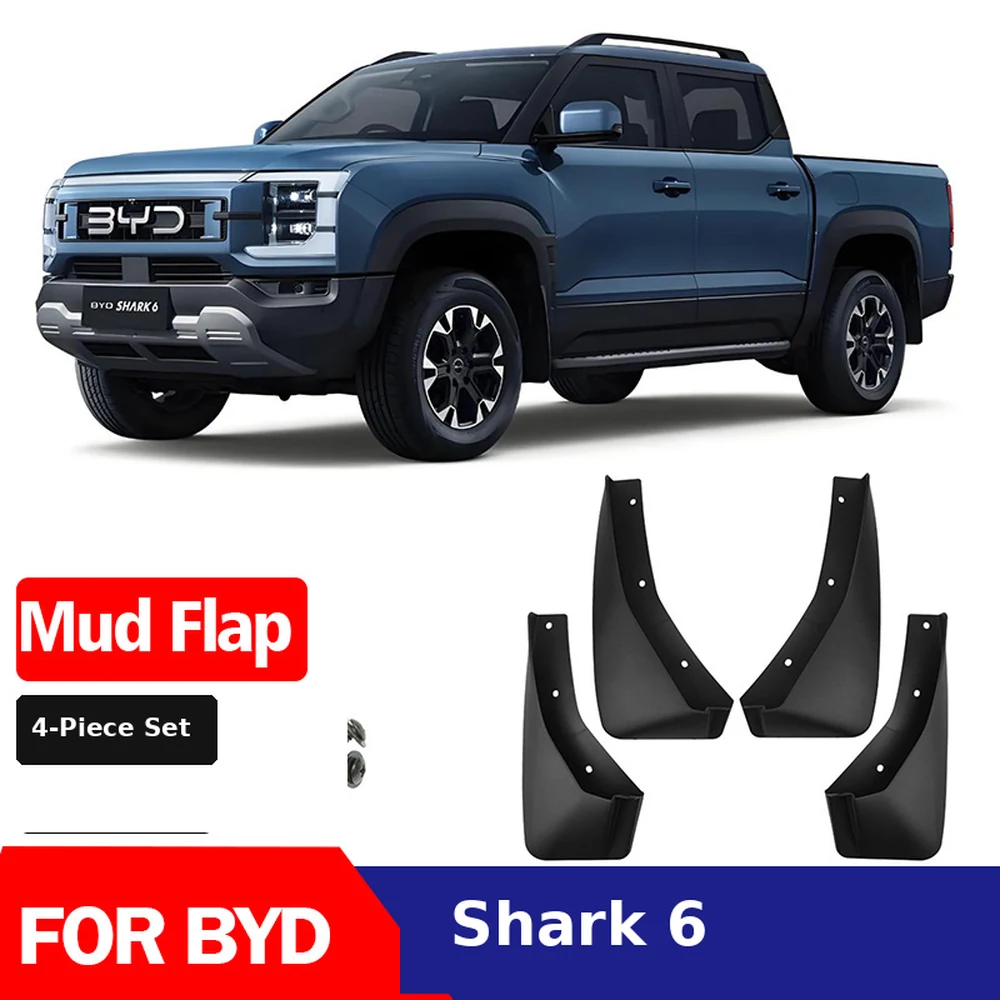
For example, the Shark 6 set is specified as soft PP, while the 2024–2025 Yuan Up / Atto 2 set is specified as PVC. Those descriptions identify different materials, not a controlled comparison proving that either set is tougher, better in snow or suitable for the other vehicle.
Compare the area around the fixing, not just the hanging edge
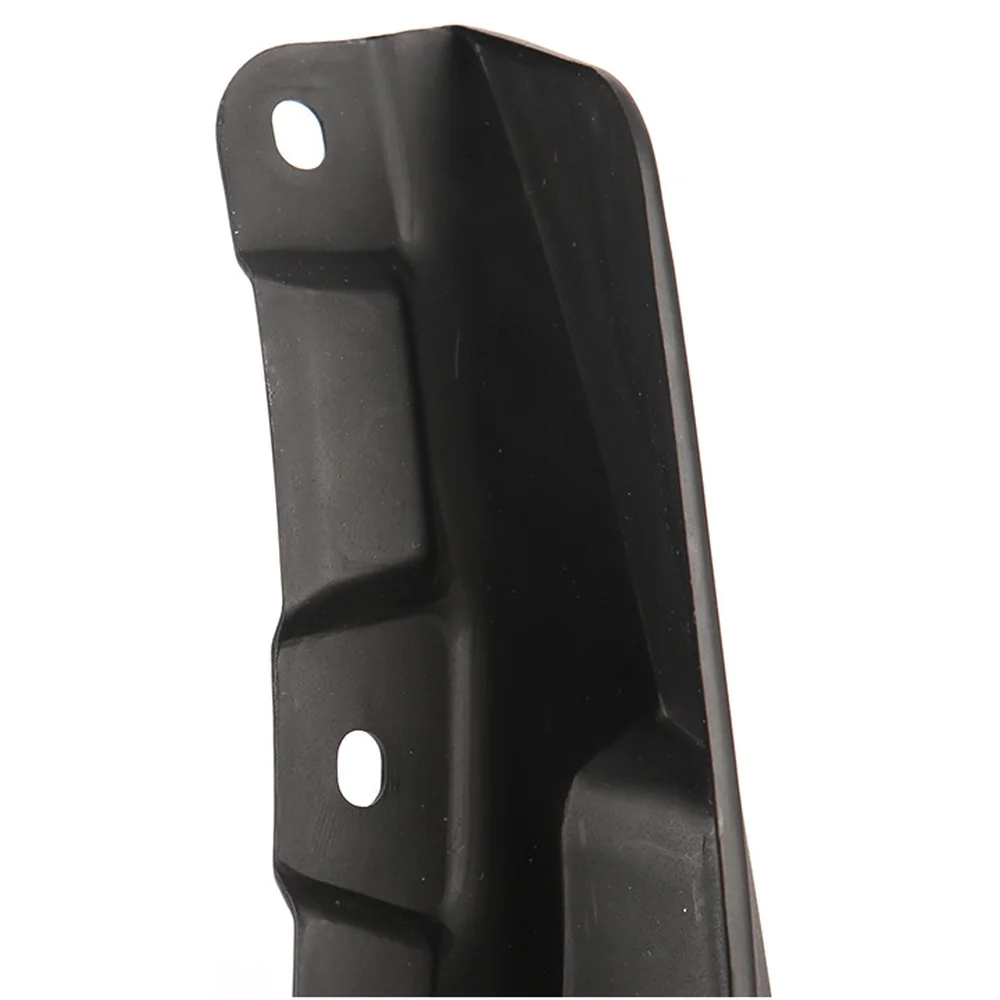
A flexible lower portion does not tell you how the fixing is supported. Look at the hole and the face under the screw head or washer: does the intended hardware bear on the designed mounting area, and does that area sit against its matching surface? A proud edge pulled flat by tightening is an alignment problem, not a reason to buy a harder polymer.
Thickness also changes the connection. The Essentra fastener guide specifies compatible panel-thickness ranges for rivets. If a thicker flap is added to the liner, the old clip may no longer suit the total stack. More thickness therefore needs a corresponding fastener and clearance check; it is not an automatic upgrade.
Use the failure you want to avoid to select the evidence
- Winter impact: ask for impact or flexibility evidence at the temperature that matters to you, including the test method and whether it concerns the compound or the finished part. Warm-hand bending cannot answer that question.
- Cracks or tears around the mount: inspect the receiver, alignment and bearing area as well as the material. A different polymer will not restore a broken receiving point.
- Outdoor ageing: look for documented weathering/UV performance for the supplied compound or part. A black colour or “heavy duty” label is not that evidence.
- A close-to-body appearance: compare the fitted profile and finish. A carbon-look pattern identifies appearance, not proof of carbon-fibre construction or impact strength.
If two candidates have no comparable performance data, choose only on the features you can establish—correct fit, supplied hardware, dimensions and the visible design. Do not pay a premium for an unsubstantiated winter or lifetime claim. Where a specific cold-weather requirement is essential, obtain that evidence before ordering rather than treating either “rubber” or “soft PP” as the answer.


 English
 Portuguese
 French
 Turkish
 Russian
 Arabic
 Spanish