
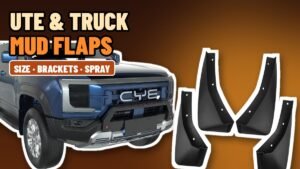
After changing wheels or tyres, check two separate things: does the flap still cover the intended width, and does the tyre remain clear of it? A wider flap can address a width shortfall but will not necessarily cure contact. Cutting a rubbing edge can remove coverage without correcting an unsuitable wheel or mounting arrangement.
Record the original and replacement tyre sizes, wheel width and offset, and any suspension or arch changes. Keep front and rear specifications separate. A claim that a flap fits your BYD model does not establish compatibility with a changed wheel package.
First, read what changed in the tyre size
Michelin’s tyre-marking explanation identifies the first number as nominal section width, the second as sidewall height expressed as a percentage of that width, and the number after R as rim diameter in inches. Rim diameter is not the tyre’s overall diameter.
Illustrative calculation—not a BYD fitment recommendation: compare 225/45 R18 with 235/45 R18. Both fit an 18-inch rim diameter, but the nominal sidewall heights are 225 × 0.45 = 101.25 mm and 235 × 0.45 = 105.75 mm. The nominal radius therefore grows by 4.5 mm as well as the nominal section width increasing by 10 mm.
That explains why “same 18-inch wheels” is not enough information for a clearance enquiry. These are label-based calculations, not measured tyre envelopes; the actual tyre, rim and vehicle combination still has to be assessed.
Locate the width shortfall
On a safely parked vehicle with the wheels straight ahead, photograph each wheel square-on from the front or rear, showing the tyre, arch edge and flap edge together. Avoid a wide-angle view taken close to one corner: perspective can hide which edge is farther out.
Look at two separate relationships:
- Tyre to arch: does the wheel/tyre sit outside the original body protection? That is a wheel-and-guard coverage issue, not something a longer panel behind the tyre automatically fixes.
- Tyre to flap: does part of the tyre’s width extend beyond the flap’s working face? That identifies where a flap would need additional coverage, but does not establish which bracket or blank can be fitted.
The legal coverage standard depends on the vehicle category and jurisdiction. Use a coverage photograph to identify the shortfall, not to certify the wheel conversion.
Locate contact before choosing a remedy
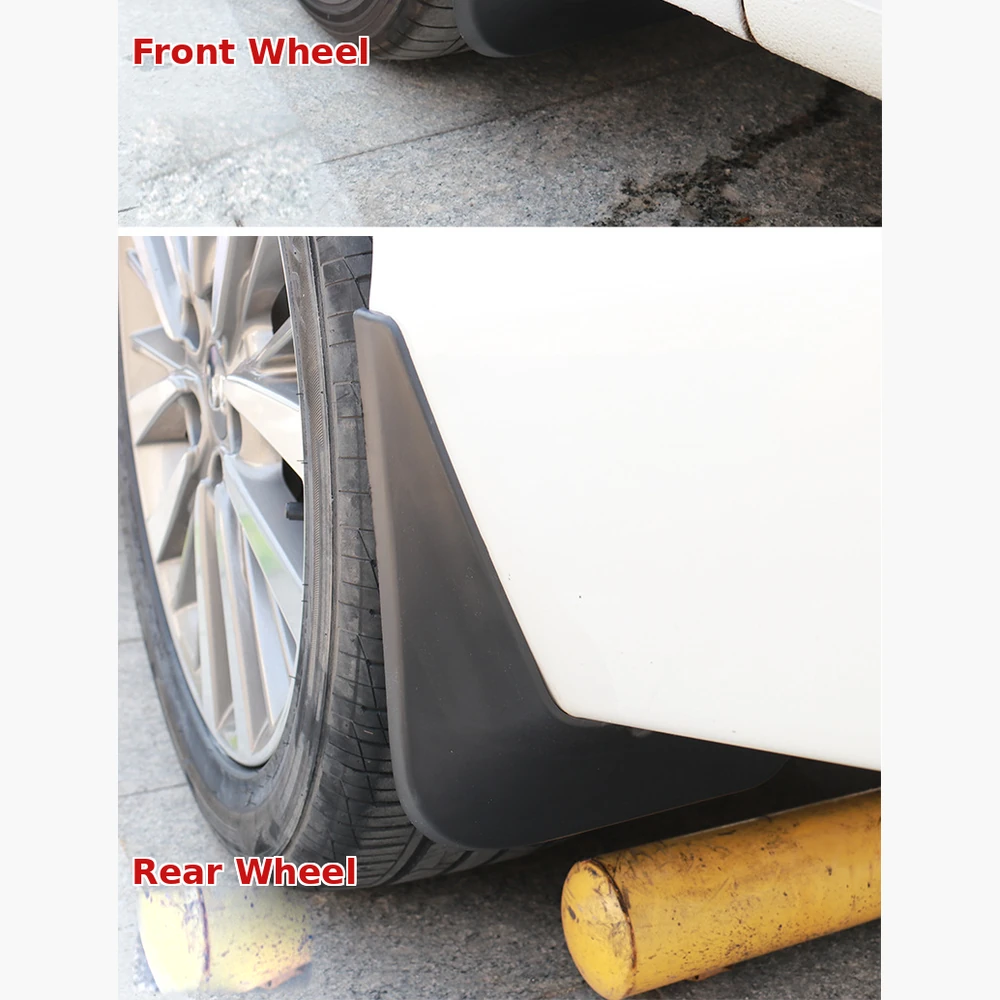
Fresh abrasion, a displaced flap or marks on a tyre are reasons to stop and identify the contact point. Do not drive over ramps or speed bumps to see whether a rubbing part will wear clear. If a panel is touching the tyre or can move into it, have it made safe before further driving.
| Finding | Question it answers | Next action |
|---|---|---|
| The flap has moved because a fixing is missing or its receiver is loose. | The part is no longer at its intended mounting position. | Restore or repair the specified mounting connection before judging whether its shape needs changing. |
| The tyre contacts an otherwise correctly located flap during steering. | The installed combination lacks clearance at that position. | Have the tyre, wheel and flap arrangement assessed. Do not force the panel aside, fit a generic spacer or cut near a mounting feature. |
| No contact is visible with the car parked and the steering moved. | Only the observed static positions are clear. | Complete the required suspension-travel and loaded-condition assessment; a static check alone does not establish that the conversion clears throughout travel. |
| Contact is with the liner, body or suspension rather than the flap. | A different component is involved. | Resolve the wheel/tyre conversion itself. Removing or shortening the flap will not remove that separate interference. |
Why a full-lock photograph is not the final test
The Queensland Light Vehicle Inspection Manual effective 7 July 2026 rejects wheels rubbing or fouling over their full range of travel, and tyre contact with the body, inner guard, braking, steering or suspension components. That is broader than steering the parked car from side to side.
A workshop assessing a conversion needs to establish clearance using the procedure appropriate to the vehicle and modification. Bouncing one corner by hand or adding passengers does not demonstrate every suspension position. The Queensland criteria are an example of the required distinction, not approval of a modification elsewhere.
Specify the problem before buying another flap
Send the installer the before-and-after tyre sizes, rim width and offset, modification details, the straight-ahead coverage photographs and a close-up locating any contact. State whether the problem is width, contact, a displaced mounting point, or more than one of these.
A different bracket is an option only when its compatibility, mounting method and clearance are documented for the setup. Use the documented bracket dimensions for that vehicle, not a generic stand-off distance. Do not add a wheel spacer to solve mud-flap contact; wheel-spacing changes have their own mechanical and legal requirements.

 English
 Portuguese
 French
 Turkish
 Russian
 Arabic
 Spanish