
BYD’s overseas revenue hit 53% of total in H1 2026, a historic first, as China sales slumped 46%. The Shenzhen automaker reported 181.3 billion yuan ($27B) in overseas revenue, up 34% YoY, while domestic revenue fell 31%. This shift underscores BYD’s aggressive global expansion amid a brutal price war at home. For overseas buyers, it means more models, better supply, and stronger after-sales support. Here’s a detailed breakdown of BYD’s financials, sales performance, and what it signals for the EV industry.
BYD Overseas Revenue Surpasses China for First Time
In the first half of 2026, BYD’s overseas revenue reached 181.3 billion yuan ($27 billion), accounting for 53% of its total revenue of 344.8 billion yuan ($50.9 billion). This historic milestone marks the first time the company earned more from international markets than its domestic base. Overseas revenue grew 34% year-on-year, while China revenue declined 31%, reflecting BYD’s global momentum against domestic headwinds.
The gross margin for overseas operations hit 22%, up 1.9 percentage points from a year earlier, boosting BYD’s overall gross margin to 18.85% from 18.01%. This improvement was driven primarily by the overseas vehicle business, which commands higher prices and healthier profitability. Despite the revenue shift, total revenue fell 7.1% year-on-year, and net profit attributable to shareholders dropped 20.5% to 12.3 billion yuan ($1.8 billion), underscoring the financial strain of the domestic price war.
China Sales Plummet: BYD Brand Down 45.9%
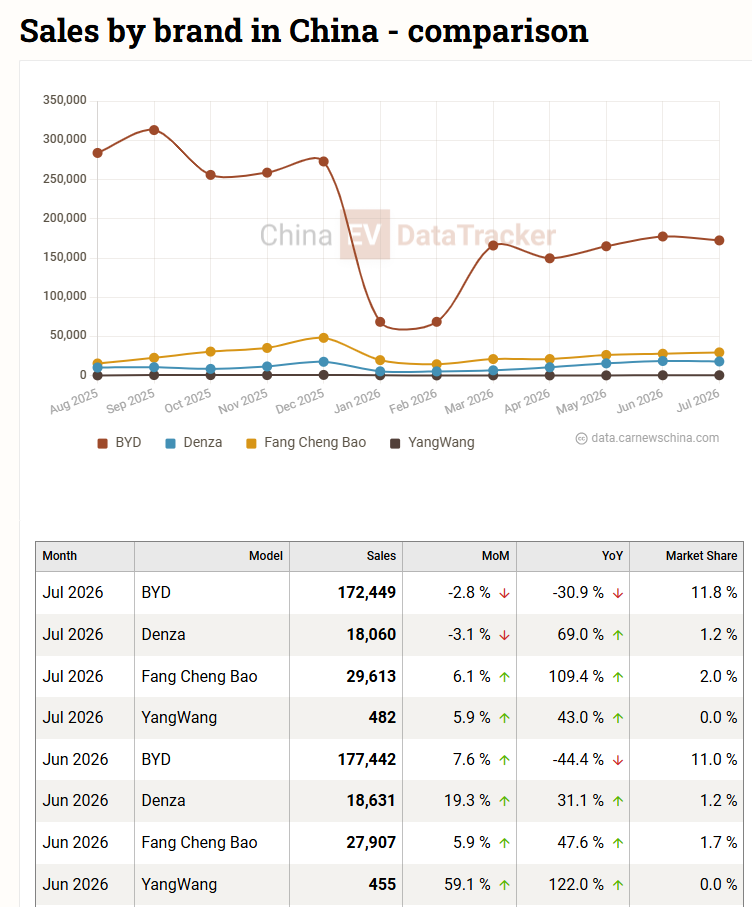
BYD brand vehicle registrations in China totaled 795,169 units in H1 2026, a sharp 45.9% decline year-on-year, according to China EV DataTracker. This slump is largely attributed to intense competition and a prolonged price war that has eroded margins across the industry. Other BYD Group brands fared better: Fang Cheng Bao registered 131,000 vehicles, up 115% year-on-year, but this growth was insufficient to offset the main brand’s losses.
The domestic market’s weakness is not new. BYD Group sold 2,288,709 PHEVs in 2025, down 7.9% from 2024, and the trend continued into 2026. Between January and August 2026, PHEV sales fell 11.2% to 1,265,017 units. However, July and August showed a recovery, with total global sales of 844,456 vehicles, up 18.5% year-on-year, driven by a 29.6% surge in BEV sales, while PHEVs grew just 6%. This suggests BYD may have found new momentum for the second half.
Overseas Sales Surge 70.6% in H1 2026
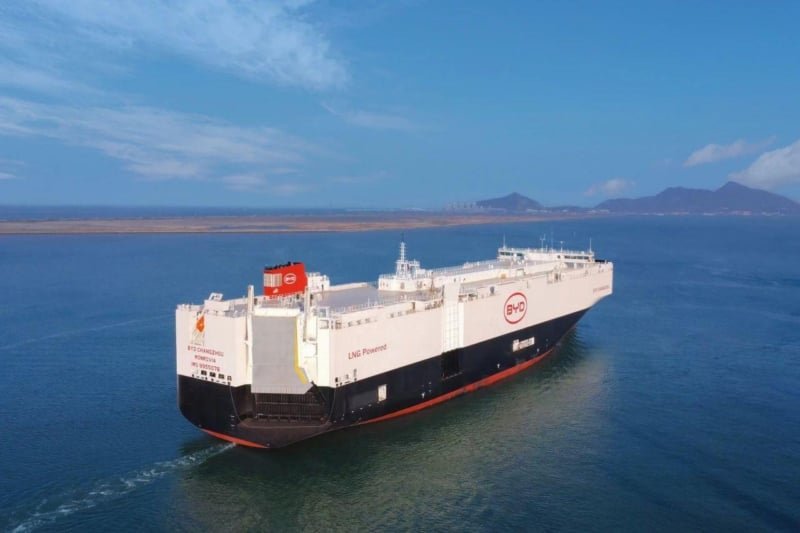
BYD sold 792,256 vehicles outside China in the first half of 2026, up 70.6% from the same period last year. The acceleration continued into August, with a record 190,000 vehicles sold overseas, a 134% increase year-on-year. These figures include all BYD Group brands—Denza, Fang Cheng Bao, and Yangwang—and highlight the company’s aggressive international push.
Brazil has emerged as BYD’s largest market outside China, while the automaker is building local manufacturing plants in Brazil, Hungary, and Turkey to meet regional demand and avoid tariffs. This expansion is part of a broader strategy to diversify revenue streams and reduce dependence on the volatile Chinese market. For overseas buyers, this means more BYD models available globally, with improved supply chain and after-sales support.
Domestic Market Pressure: Industry-Wide Decline
BYD’s struggles are not isolated. China’s passenger vehicle retail sales fell 21.1% year-on-year in July, marking the tenth consecutive monthly decline, according to the China Passenger Car Association (CPCA). The domestic market is oversaturated, with over 100 auto brands still competing, leading to a cutthroat price war that has squeezed profits across the board.
In contrast, China’s passenger vehicle exports increased by 88.2%, underscoring the growing importance of international markets for Chinese automakers. BYD’s shift overseas is a strategic response to this dichotomy, leveraging its competitive pricing and technology to capture market share abroad. The company’s overseas gross margin of 22% is significantly higher than its domestic margin, making international expansion a key driver of profitability.
BYD’s Global Sales Trajectory: 2022–2026
BYD’s global sales have grown exponentially, with overseas sales playing an increasingly vital role. In 2022, total sales were 1,857,379 units, with only 50,021 overseas. By 2025, total sales reached 4,550,036, and overseas sales jumped to 1,046,083. As of September 1, 2026, BYD has sold 2,621,777 vehicles globally in January–August, with 1,161,563 sold overseas—already surpassing 2025’s full-year overseas total.
This trajectory highlights BYD’s successful pivot to international markets. The company’s ability to scale production and distribution globally, combined with its innovative EV technology like the Bateria de lâminas, positions it as a formidable player in the global EV market. For B2B buyers, this means a reliable supply of BYD vehicles and components, backed by a robust export infrastructure.
Financial Performance and Profitability Analysis
Despite the revenue shift, BYD’s overall financial performance in H1 2026 reflects both challenges and opportunities. Total revenue declined 7.1% year-on-year to 344.8 billion yuan, primarily due to the domestic downturn. However, the overseas segment’s higher margins helped mitigate the impact on profitability. Net profit attributable to shareholders fell 20.5% to 12.3 billion yuan, a significant drop but less severe than the domestic sales decline might suggest.
The overseas gross margin of 22% is a key highlight, up from 20.1% a year earlier. This improvement is attributed to a richer product mix, with higher-priced models like the Denza and Yangwang brands gaining traction abroad. Additionally, BYD’s local manufacturing in key markets reduces logistics costs and tariff exposure, further boosting margins. For investors, this indicates that while the domestic market remains under pressure, the overseas expansion is providing a profitable growth avenue.
Analysts note that BYD’s ability to maintain an 18.85% overall gross margin is commendable given the price war. The company’s vertical integration, from batteries to semiconductors, gives it a cost advantage that competitors struggle to match. As BYD scales overseas, economies of scale are expected to further reduce costs, potentially improving margins in the second half of 2026.
Implications for the Global EV Market
BYD’s revenue milestone is not just a company achievement; it signals a broader shift in the global automotive industry. Chinese automakers, led by BYD, are increasingly challenging established players in Europe, Southeast Asia, and Latin America. BYD’s overseas success is built on its technological leadership in EVs, particularly its Blade Battery and DM-i hybrid systems, which offer safety and efficiency.
For international markets, this means more affordable and advanced EV options. BYD’s aggressive pricing, combined with local production, is likely to accelerate the transition to electric vehicles in emerging markets. Traditional automakers will face intensified competition, potentially leading to consolidation and innovation across the industry. For consumers, this is a win, as it drives down prices and expands choice.
Moreover, BYD’s strategy of setting up plants in Brazil, Hungary, and Turkey serves as a template for other Chinese automakers. By localizing production, they can circumvent trade barriers and build brand trust. As BYD continues to expand, it is poised to become a top-three global automaker by sales volume within the next few years, reshaping competitive dynamics.
O que ver a seguir
As BYD continues to expand overseas, watch for further production ramp-ups in Brazil, Hungary, and Turkey, which will shorten delivery times and reduce costs for international buyers. The company’s second-half momentum, driven by BEV sales, could lead to record annual exports. Additionally, monitor how BYD navigates the domestic price war—any stabilization in China could boost overall profitability. For the latest on BYD’s global strategy and model availability, explore our Modelos de automóveis da BYD page.
Chamo-me Lucian e trabalho na BYD Sourcing. Com mais de 10 anos de experiência no setor automóvel e experiência prática em procedimentos de exportação e desalfandegamento, ajudo compradores estrangeiros a adquirir veículos elétricos chineses — especialmente modelos da BYD — através de canais oficiais e verificados, tanto para venda a retalho como por grosso. Contacte-nos para obter um orçamento competitivo.



 English
 Portuguese
 French
 Turkish
 Russian
 Arabic
 Spanish