

The second-gen BYD Seagull has started arriving at dealerships across China ahead of its official domestic launch, giving buyers and industry observers a first close look at the heavily revised urban EV. Display cars finished in orange are now appearing in showrooms, a strong signal that the formal market debut is only weeks away. The new model brings a long list of upgrades, including flash charging technology, the DiPilot 300 assisted driving system, and a more powerful 127 hp electric motor. Pre-orders for the second-gen BYD Seagull opened on October 9 with a 2,000 yuan deposit, although the final price has not been disclosed. This early dealer arrival lets BYD build buzz and gauge real demand before the launch event.
For readers tracking BYD’s product offensive, this is one of the most important small-car refreshes of the year. The Seagull has been a volume leader for the brand, and the second generation is designed to defend that position against a wave of newer, cheaper rivals. You can follow our ongoing coverage of BYD’s latest models at BYD Car China.
Exterior Design and Dimensions
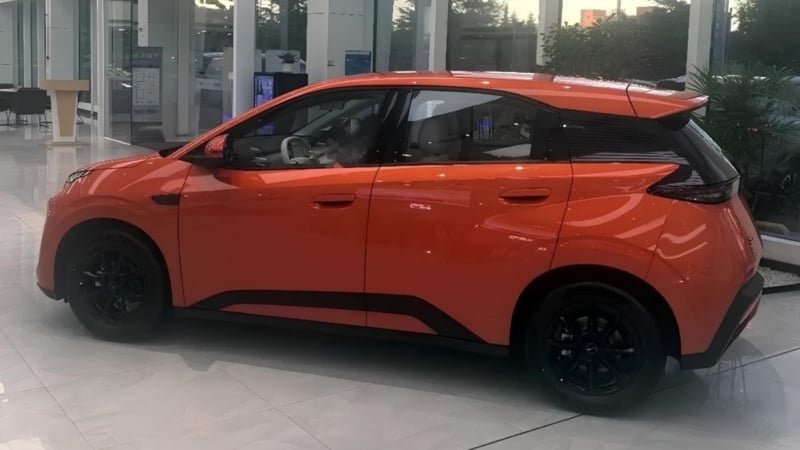
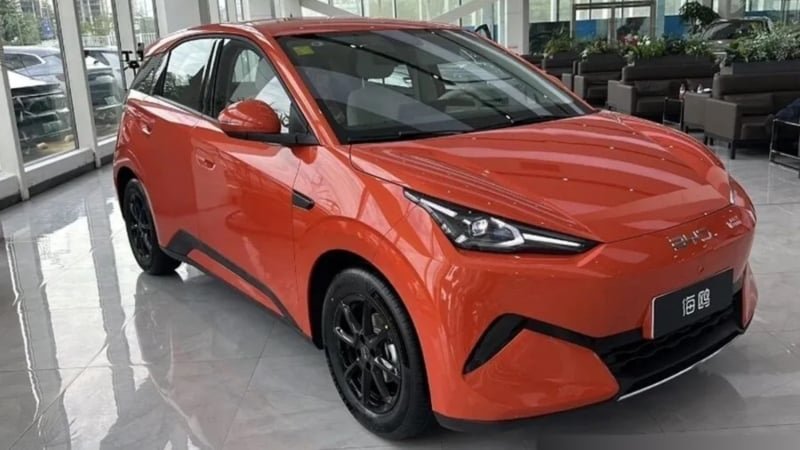
The second-gen BYD Seagull adopts a fresh exterior that clearly separates it from the outgoing car. The dealer display model is painted orange, one of six available colors that also include green, white, pink, blue, and gray. Exterior highlights include blacked-out 16-inch rims, semi-hidden door handles, and a floating roof design that gives the small hatchback a more modern, upscale look.
The most significant change is size. The second-gen BYD Seagull now measures 4205 mm long, 1810 mm wide, and 1570 mm tall, with a wheelbase of 2650 mm. That is a 425 mm increase in length compared with the ongoing first-generation model, which translates into more interior room and a more substantial presence on the road. The wider track and longer wheelbase should also improve stability at highway speeds. In the crowded compact EV segment, these expanded dimensions make the Seagull a more practical choice for small families and urban commuters who still want easy parking.
Interior Features and Technology
Inside, the second-gen BYD Seagull features a clean, minimalist cabin finished in white. A two-spoke steering wheel sits ahead of the driver, with the gear shifter mounted behind it, a layout that frees up space and simplifies controls. Notably, there is no traditional LCD instrument cluster. Instead, the left portion of the central screen serves as the instrument panel, a cost-saving and space-efficient solution that also keeps the driver’s attention on one display.
The center tunnel houses a wireless phone charger, a block of physical buttons, and two cup holders, blending convenience with tactile controls that many buyers still prefer over touch-only interfaces. Another practical highlight is the electrically powered frunk, which adds storage space under the hood. These features reflect BYD’s focus on smart packaging and user-friendly technology for daily urban driving. For a brand known for value, the cabin design shows that the second-gen BYD Seagull is not just a bigger car but a more thoughtfully packaged one.
Powertrain and Battery Options
The second-gen BYD Seagull is equipped with a 95 kW (127 hp) electric motor mounted on the rear axle, delivering lively performance for city driving. Buyers can choose between two battery options: a 30 kWh pack and a larger 39.2 kWh pack. CLTC range varies from 320 km to 420 km, which translates to approximately 262 km to 344 km under WLTP conditions. That spread gives shoppers a clear choice between a lower-cost urban runabout and a longer-range variant for occasional intercity trips.
One of the most impressive features is the flash charging technology, which allows the battery to charge from 10% to 97% in just nine minutes. This rapid charging capability addresses one of the key concerns for EV buyers and makes the Seagull a compelling choice for those without easy home charging access. The combination of rear-wheel drive and quick charging sets a new benchmark for affordable EVs. If the real-world charging curve matches the claim, the second-gen BYD Seagull could change expectations for what an entry-level electric car can do.
Assisted Driving and DiPilot 300
The second-gen BYD Seagull is slated to offer the DiPilot 300 assisted driving system, also known as “God’s Eye B,” which supports Navigate On Autopilot functionality. However, the display model that arrived at dealers notably lacks a LiDAR sensor on the roof, which is typically a key component of the DiPilot 300 system. This discrepancy suggests that the showroom car may be a lower trim, or that the LiDAR-equipped version will be reserved for higher-end variants.
The DiPilot 300 system is expected to provide advanced driver assistance features, including highway and urban navigation assistance, making the Seagull one of the most affordable vehicles with such capabilities. As the launch approaches, more details about the standard and optional ADAS configurations will likely emerge. Buyers should watch for trim-level breakdowns, because the gap between a basic car and a LiDAR-equipped one could be significant in both price and capability. For now, the dealer display car tells us that the second-gen BYD Seagull will offer advanced assistance, but not necessarily on every version.
Pricing, Pre-Orders, and Market Positioning
Pre-orders for the second-gen BYD Seagull opened on October 9 with a 2,000 yuan (approximately 300 USD) deposit. The final price has not been announced, a common strategy in China that allows automakers to generate buzz and assess demand based on booking numbers. The deposit is fully refundable before the order is locked, which lowers the risk for early reservation holders.
The new Seagull is expected to be priced below 100,000 yuan (14,915 USD), positioning it competitively in the entry-level EV market. For context, the ongoing first-generation Seagull is priced between 69,900 and 85,900 yuan (10,425 – 12,810 USD). The second-gen model’s expanded dimensions and advanced features may justify a slightly higher price point, but BYD is likely to keep it accessible to maintain its volume leadership. If the company can hold the line near the top of the current range while adding flash charging and a bigger body, the second-gen BYD Seagull will be hard for rivals to match on value. You can compare this with other BYD models in our BYD car reviews.
Sales Performance and Market Context
The first-generation BYD Seagull has been a strong seller, but recent figures show a decline. From January to August 2026, the ongoing Seagull delivered 74,087 units, down 66.5% year-on-year, according to China EV DataTracker. This drop reflects increased competition in the entry-level EV segment and possibly cannibalization from newer models. The second-gen Seagull is expected to reverse this trend by offering substantial improvements in size, technology, and charging speed.
BYD’s strategy of refreshing popular models with significant upgrades aims to maintain its dominance in the Chinese EV market. The Seagull’s success is crucial for BYD’s volume targets, and the early dealer arrival indicates the company is eager to build momentum ahead of the launch. The decline also shows how quickly the small EV segment is evolving in China, where newer rivals keep raising the bar on range, features, and price. A successful second-gen launch would not only recover lost volume but also reinforce BYD’s reputation for rapid product improvement.
What to Watch Next
BYD is expected to officially launch the second-gen Seagull in the coming weeks, with full pricing and trim details to be announced. Key things to watch include whether the LiDAR-equipped DiPilot 300 will be available on all trims or limited to higher-end versions, and how the final price compares to the first-generation model. Additionally, the real-world performance of the flash charging technology and its impact on charging infrastructure will be important. If the nine-minute 10% to 97% claim holds up in everyday use, it could reshape how buyers think about affordable EVs.
As the launch nears, we will monitor dealer inventories and early sales data to gauge market reception. For overseas buyers, the second-gen Seagull could become an attractive export model if BYD decides to offer it in international markets. Its combination of compact dimensions, quick charging, and advanced driver assistance would suit many markets where urban EVs are in demand. Until then, the dealer arrival gives us the clearest preview yet of what BYD has planned for its next-generation city car.




 English
 Portuguese
 French
 Turkish
 Russian
 Arabic
 Spanish