

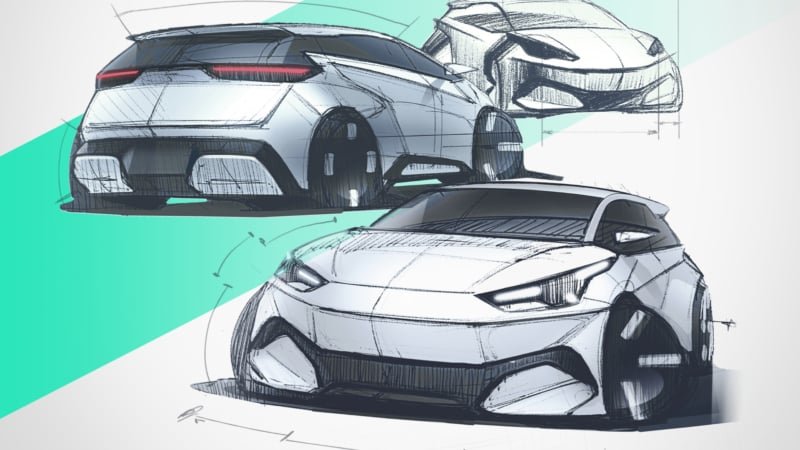
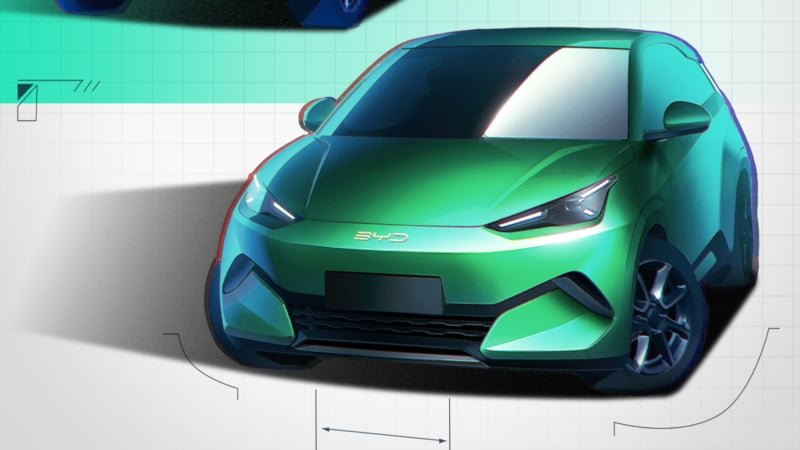
Design sketches of the second-gen BYD Seagull were revealed in China, giving overseas buyers a first official look at the upcoming urban hatchback. The images were shared by Zhang Zhuo, general manager of BYD’s Ocean network sales division. He previously said the model would enter the domestic market under the “Great Seagull” (Da Haiou) name, but in his latest post he called it “the second-gen Seagull.” The new model is 425 mm longer than the ongoing first-gen Seagull and will shortly enter the Chinese domestic market. The sketches highlight a completely new layout with expanded interior space, signaling a significant update to one of BYD’s most affordable EVs.
What the design sketches show
The shared design sketches reflect the development process of this urban hatchback. It adopts large trident-shaped headlights, sharp body surfaces, and wide wheel arches. A lowered glass line aims to create a more dynamic look. Other highlights include eight-spoke 16-inch rims and thin taillights. The sketches suggest a more aggressive and modern stance compared to the current Seagull, which has been a volume seller in China’s entry-level EV segment. The new design language appears to move the Seagull closer to BYD’s newer Ocean series models, with a focus on aerodynamic efficiency and visual width. For overseas buyers, these sketches provide an early indication of the styling direction for what could become a global model. BYD has not yet announced export plans for the second-gen Seagull, but the first-gen model has been sold in several international markets. You can explore BYD’s current lineup at BYD car models.
Dimensions and platform details
The second-gen BYD Seagull was previously spotted in the wild in China and has applied for a domestic sales license, revealing core specs. It offers dimensions of 4205/1810/1570 mm and a wheelbase of 2,650 mm. For clarity, it is 425 mm longer than the regular BYD Seagull. Moreover, the new car is only 65 mm shorter than the BYD Dolphin. This size increase moves the Seagull closer to the compact hatchback segment, potentially appealing to buyers who need more interior space but still want a small footprint. The wheelbase of 2,650 mm is particularly notable, as it should provide significantly more rear legroom than the first-gen model. The wider track and longer body also suggest improved stability and ride comfort. These dimensions place the second-gen Seagull in a competitive position against other small EVs in China and potentially in export markets.
Powertrain and battery options
The new BYD Seagull adopts a single electric motor for 95 kW (127 hp) powered by a FinDreams-made LFP battery. Two FinDreams-made LFP battery options are available: 30 kWh and 39.2 kWh, suitable for 320 – 420 km of CLTC range. The top speed reaches 150 km/h. This powertrain represents a substantial upgrade over the first-gen model, which typically offered lower power output. The use of FinDreams LFP batteries aligns with BYD’s strategy of vertical integration and cost control. The 30 kWh version will likely target urban commuters, while the 39.2 kWh version offers longer range for those who need more flexibility. The CLTC range figures are measured under Chinese test conditions, so real-world range may vary, but they indicate competitive performance for the segment. For more on BYD’s battery technology, see BYD Blade Battery.
Advanced driver assistance and LiDAR
The new model adopts a roof-mounted LiDAR sensor. It is part of the DiPilot 300 (“God’s Eye B”) assisted driving system. Its functionality includes the Navigate On Autopilot (NOA) function on urban roads and highways. This is a significant addition for an entry-level hatchback, as LiDAR-based ADAS is typically reserved for higher-priced vehicles. The DiPilot 300 system is expected to provide advanced driver assistance features that could rival more expensive competitors. The roof-mounted LiDAR also gives the second-gen Seagull a distinctive look, with a small pod on the roof. For overseas markets, the availability of such advanced features could be a strong selling point, though regulatory approval for LiDAR-based systems varies by country. BYD has been aggressively rolling out its “God’s Eye” ADAS across its lineup, and the Seagull’s inclusion shows the technology is trickling down to affordable models.
Interior and cabin features
Earlier spy photos of the second-gen Seagull’s cabin revealed a floating screen, a gear shifter behind the wheel, and a sizeable center tunnel. These features suggest a more modern and practical interior compared to the first-gen model. The floating screen is likely part of BYD’s latest infotainment system, which supports over-the-air updates and connected services. The gear shifter behind the wheel frees up space in the center console, while the sizeable center tunnel provides additional storage. The overall layout appears to prioritize functionality and space efficiency, which is crucial in a small hatchback. The expanded interior space mentioned in the design sketches is likely a result of the longer wheelbase and wider body. These changes should make the second-gen Seagull more comfortable for passengers and more versatile for daily use.
Market context and first-gen sales
The ongoing BYD Seagull delivered 74,087 units from January to August 2026, down 66.5%, according to China EV DataTracker. Its price range lies between 69,900 and 85,900 yuan (10,440 – 12,830 USD). The sharp decline in sales highlights the need for a refreshed model. The second-gen Seagull, with its larger size, more powerful motor, and advanced features, is positioned to reverse this trend. The price of the new model has not been announced, but it is expected to remain competitive in the entry-level EV segment. BYD has a history of aggressive pricing, and the second-gen Seagull will likely undercut many rivals while offering more technology. For overseas buyers, the first-gen Seagull has been a popular choice due to its low price and decent range. The second-gen model could further strengthen BYD’s position in the global small EV market, especially if it is exported to markets like Europe, Southeast Asia, and Latin America.
What to watch next
BYD is expected to officially launch the second-gen Seagull in China in the coming months. Key details still to be confirmed include final pricing, exact trim levels, and whether the LiDAR-equipped DiPilot 300 will be standard or optional. Overseas buyers should watch for announcements regarding export availability and homologation for their markets. As the model gets closer to launch, more specifications and real-world tests will emerge. For sourcing inquiries, visit BYD Sourcing.
I’m Lucian from BYD Sourcing. With more than 10 years in the automotive industry and hands-on experience with export procedures and customs clearance, I help overseas buyers source Chinese EVs – especially BYD models – through official, verified channels, for both retail and wholesale. Contact us for a competitive quote.

 English
 Portuguese
 French
 Turkish
 Russian
 Arabic
 Spanish