

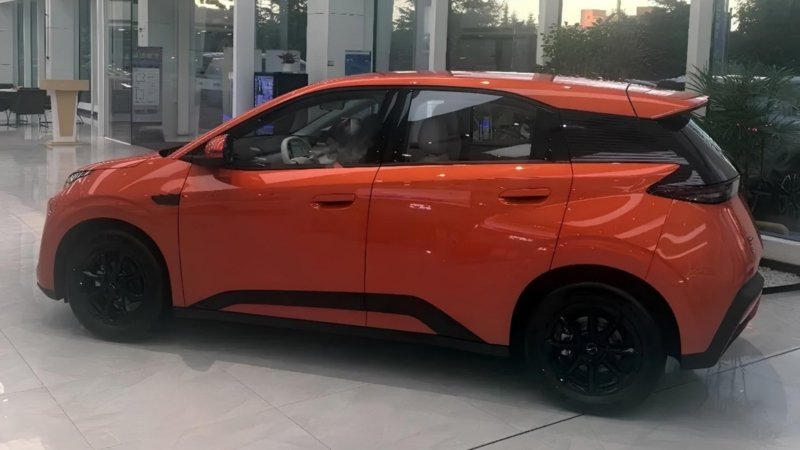
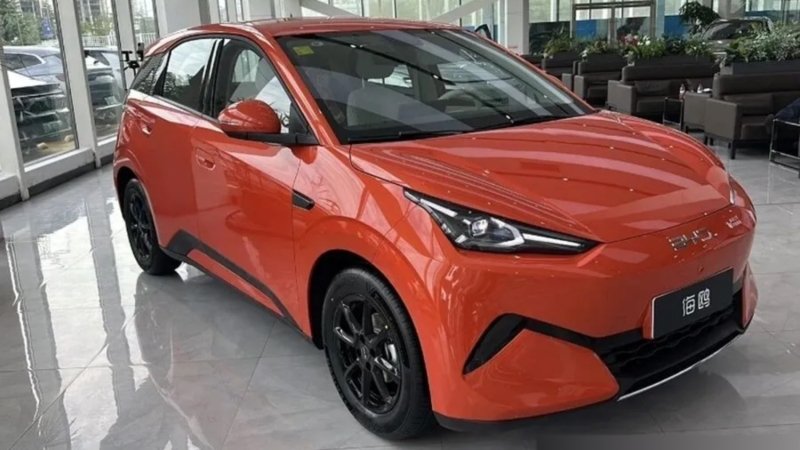
The second-generation BYD Seagull has arrived at dealerships across China ahead of its domestic launch, giving buyers and industry watchers a first look at the updated urban EV. The display model, finished in orange, was photographed at a dealer and signals that BYD is moving quickly to refresh its entry-level electric hatchback. The new Seagull brings significant upgrades over its predecessor, including flash charging technology, the DiPilot 300 advanced driver assistance system, and a more powerful 127 hp electric motor. It also grows in size, addressing one of the main criticisms of the first generation. Pre-orders opened on October 9 for a 2,000 yuan deposit, and the official price is expected to be announced soon. The arrival at dealers is a key milestone for BYD as it seeks to revitalize sales in the competitive small EV segment.
What’s New in the Second-Gen BYD Seagull?
The second-gen BYD Seagull represents a comprehensive overhaul of BYD’s popular city car. The most noticeable change is the increase in dimensions: the new model measures 4205/1810/1570 mm with a wheelbase of 2,650 mm. That makes it 425 mm longer than the outgoing first-generation Seagull, which should translate to more interior space and a more substantial road presence. The design also evolves with blackened 16-inch rims, semi-hidden door handles, and a floating roof, giving it a more modern and aerodynamic look. The display car’s orange paint is one of six colors available, alongside green, white, pink, blue, and gray. Inside, the cabin is finished in white and features a two-spoke steering wheel with a gear shifter behind it, a wireless phone charger, physical buttons, and two cup holders. Notably, there is no traditional LCD instrument cluster; instead, the left portion of the central screen serves as the instrument panel, a cost-saving and space-efficient solution.
Powertrain and Battery Options
The new Seagull is built on a rear-wheel-drive platform with a 95 kW (127 hp) electric motor mounted on the rear axle. Two battery options are available: 30 kWh and 39.2 kWh. These provide a CLTC range of 320 km to 420 km, which translates to approximately 262 km to 344 km under the WLTP cycle. The highlight is the flash charging technology, which BYD claims can charge the battery from 10% to 97% in just nine minutes. That is a remarkable figure for an entry-level EV and could set a new benchmark in the segment. The Seagull also features an electrically powered frunk, adding practicality for urban drivers. For more details on BYD’s battery technology, visit our Blade Battery page.
DiPilot 300 and the LiDAR Question
BYD is equipping the second-gen Seagull with its DiPilot 300 advanced driver assistance system, also known as “God’s Eye B.” This system is designed to support Navigate On Autopilot (NOA) functions, enabling assisted driving on highways and urban roads. However, the display model at the dealer was notably missing a LiDAR sensor on the roof, which is typically part of the DiPilot 300 hardware suite. This has raised questions about whether the LiDAR is optional, reserved for higher trims, or simply not installed on early display cars. It is possible that the production version will offer LiDAR as an option, or that BYD is using a different sensor configuration for the Seagull. Either way, the presence of DiPilot 300 in a car expected to cost below 100,000 yuan is a strong statement about BYD’s commitment to democratizing advanced driver assistance.
Pricing and Pre-Order Details
The second-gen BYD Seagull is not yet officially priced, but pre-orders began on October 9 with a 2,000 yuan (approximately 300 USD) deposit. This deposit is refundable at any time before the order is locked, a common practice in China that allows automakers to gauge interest and manage production planning. The final price is expected to be below 100,000 yuan (14,915 USD), positioning the Seagull as an affordable option in the Chinese market. For context, the current first-generation Seagull is priced between 69,900 and 85,900 yuan (10,425 to 12,810 USD). Given the upgrades, a slight price increase is likely, but BYD will need to keep it competitive against rivals such as the Wuling Bingo and Changan Lumin. For a full lineup of BYD models, check our BYD car models page.
Market Context: Sales Decline and Competitive Pressure
The first-generation BYD Seagull has been a strong seller, but recent data shows a significant decline. From January to August 2026, the Seagull delivered 74,087 units, down 66.5% year-on-year, according to China EV DataTracker. This sharp drop reflects intensifying competition in China’s small EV segment, where new entrants and refreshed models from competitors are vying for attention. The second-gen Seagull is clearly aimed at reversing this trend. With its larger size, longer range, faster charging, and advanced ADAS, it addresses many of the shortcomings of the original. However, the segment is price-sensitive, and BYD must balance added content with affordability. The success of the new Seagull will depend on its final pricing and how well it resonates with urban commuters and first-time EV buyers.
What This Means for Overseas Buyers
For overseas buyers, the second-gen BYD Seagull represents an attractive entry point into the EV market. Its compact dimensions, low running costs, and now-improved technology make it suitable for markets where small electric cars are in demand. The flash charging capability, in particular, could be a differentiator in regions with developing charging infrastructure. BYD has been expanding its global footprint, and the Seagull (also known as the Dolphin Mini in some markets) is expected to be part of that push. However, availability and pricing outside China will vary. Buyers should watch for official announcements regarding export markets. As a sourcing partner, BYD Sourcing can help navigate the complexities of importing Chinese EVs. For inquiries, please contact us.
What to Watch Next
The official launch of the second-gen BYD Seagull in China is imminent, and the final price will be the key factor. Also watch for confirmation on whether LiDAR is included in the DiPilot 300 package and how the model performs in real-world range and charging tests. For overseas buyers, announcements about export availability and homologation will be crucial. Keep an eye on BYD’s global expansion plans and any updates on right-hand-drive versions for markets like Southeast Asia and Europe. As the small EV segment evolves, the Seagull’s reception will indicate whether BYD can maintain its dominance in the entry-level category.
I’m Lucian from BYD Sourcing. With more than 10 years in the automotive industry and hands-on experience with export procedures and customs clearance, I help overseas buyers source Chinese EVs – especially BYD models – through official, verified channels, for both retail and wholesale. Contact us for a competitive quote.


 English
 Portuguese
 French
 Turkish
 Russian
 Arabic
 Spanish