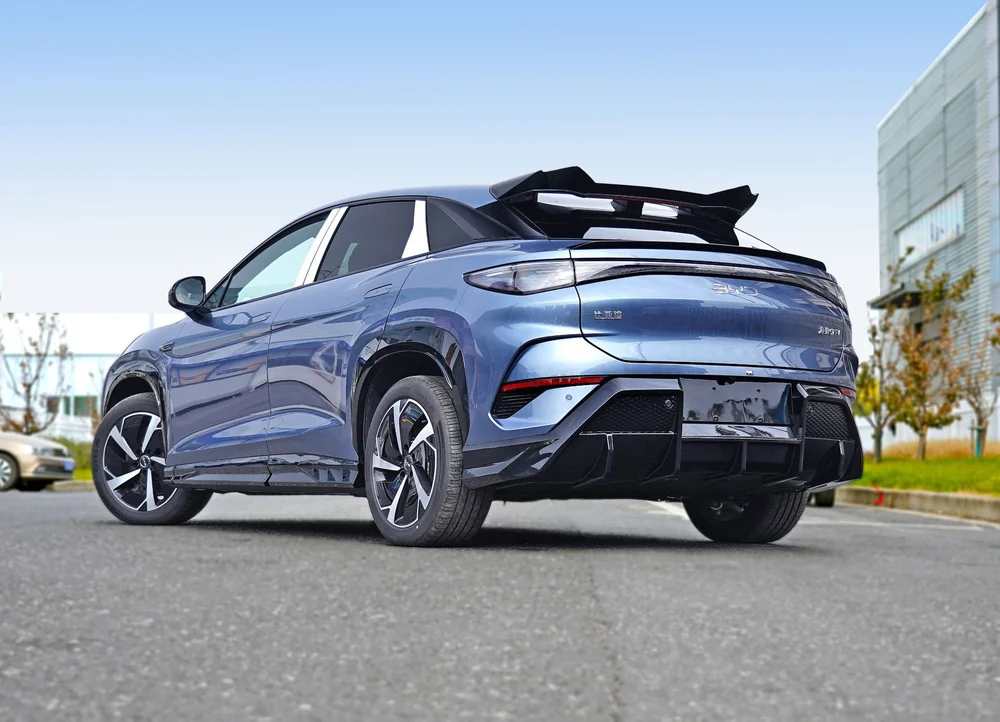
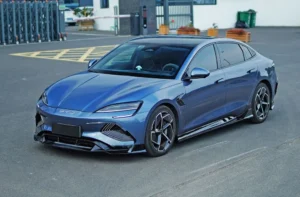
If you own a BYD SEALION 7, SEAL, ATTO 3, DOLPHIN or another BYD model in the UK, you may be considering exterior upgrades such as a front lip, rear diffuser, side skirts or rear spoiler.
In most cases, the answer is yes — non-structural exterior modifications can be used on UK roads, provided the vehicle remains safe, roadworthy and compliant with the relevant road and MOT requirements.
However, there is an important difference between installing a bolt-on styling part and making a structural modification to the vehicle.
This guide explains where that line is, what UK owners should check before installing a body kit, when DVLA notification may be required, how modifications can affect the MOT, and what to consider when modifying a BYD SEALION 7.
This guide focuses primarily on vehicles registered in England, Scotland and Wales. Northern Ireland operates a separate vehicle testing system, although many of the underlying road-safety considerations are similar.
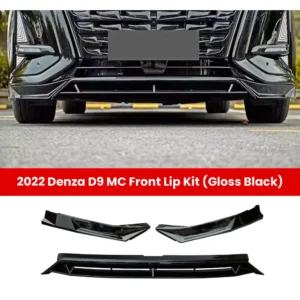
Front Bumper Lip for BYD SEALION 7
Give your BYD SEALION 7 a cleaner, sportier look with this front bumper lip. It is designed for the front lower bumper and is a practical choice for accessory shops, installers, and wholesale buyers.
Quick Answer About All You Want To Know About BYD Body Kit Installation
Question
Normal Non-Structural Body Kit
Legal on UK roads?
Generally yes
TÜV required?
No
ABE required?
No
DVLA notification required?
Normally no
IVA required?
Normally no
Special MOT after installation?
No
Government approval fee?
£0 in the normal case
Manufacturer certificate required?
Not normally
Tell your insurer?
Yes
This normally covers parts such as:
Front lips
Splitters
Side skirts
Rear diffusers
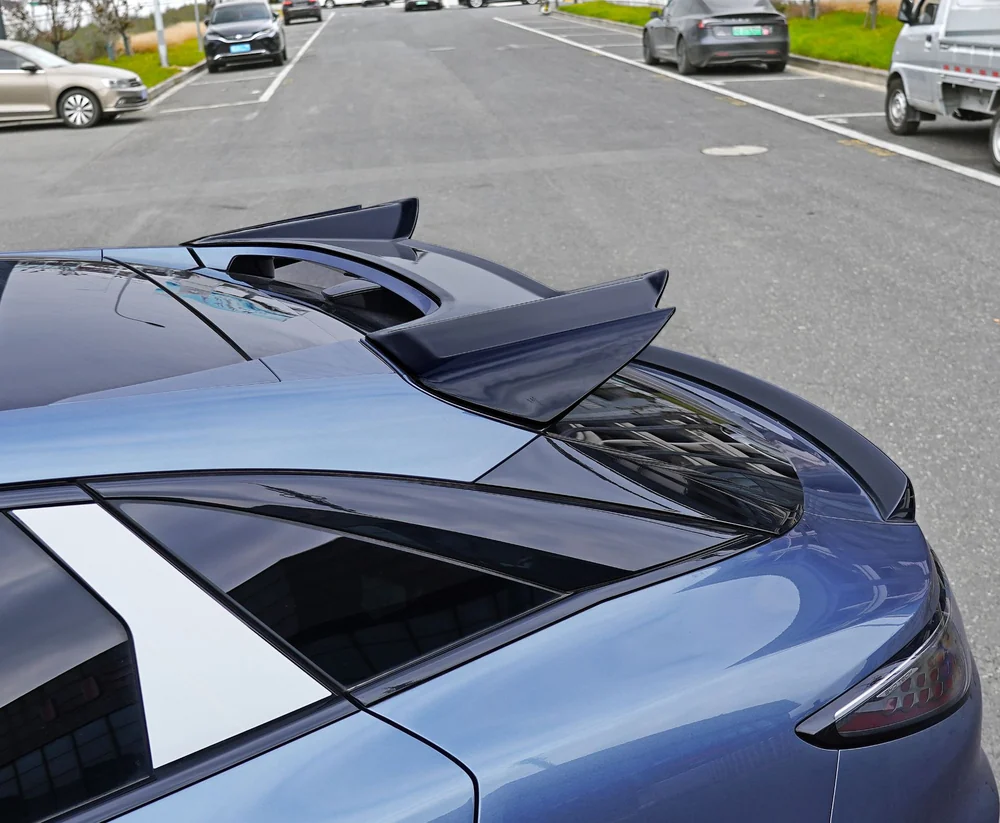
Roof spoilers
Rear spoilers
Rear wings
Bumper extensions
Mirror covers
Exterior trim
Non-structural styling panels
What Makes a Body Kit Legal in the UK?
A body kit does not become legal because it has a particular certificate.
For an already registered vehicle, the main questions are whether the modification is safe, secure and non-structural.
1. It Must Not Create a Dangerous Projection
One of the most common questions is:
How far can a front splitter or spoiler stick out?
There is no general UK rule saying that an aftermarket splitter can only extend, for example, 30 mm or 50 mm beyond the original bumper.
In other words, there is no simple rule such as:
“A front splitter may not extend more than 5 cm.”
Instead, the important issue is whether the part is likely to create a danger.
The DVSA MOT manual checks body panels, spoilers, undertrays, mirror housings and bumpers for security and potential injury risk.
A component can receive a Major defect if it is insecure or likely to cause injury. A component that may detach can be classified as Dangerous. (gov.uk)
So a larger splitter is not automatically illegal.
The real problems are:
sharp or dangerous edges
poor mounting
excessive movement
a part that may detach
a shape that creates an obvious injury risk
2. Sharp Edges Matter
UK IVA standards give a useful technical reference for exterior projections.
For vehicles undergoing IVA, DVSA uses a 100 mm sphere to assess contactable exterior surfaces.
For certain hard projections:
projections of 5 mm or more are generally assessed against a minimum 2.5 mm radius
projections below 5 mm should be blunted. (gov.uk)
However, this does not mean every spoiler or splitter fitted to an existing road car needs formal IVA measurement.
For a normal already-registered vehicle, the more practical MOT question is whether the modification is secure and likely to cause injury.
So the IVA figures are best treated as a useful technical benchmark, not as a separate approval procedure for every body kit.
3. Every Part Must Be Securely Mounted
This is one of the clearest UK requirements.
The MOT manual specifically checks:
bumpers
spoilers
body panels
other exterior body components
An insecure body component can result in a Major defect.
A component likely to become detached can be classified as Dangerous. (gov.uk)
After installation, check:
bolts
clips
brackets
adhesive areas
splitter supports
spoiler bases
diffuser mounting points
side-skirt fixings
A body kit should not move excessively when checked by hand.
4. It Must Not Interfere With Steering or Braking
A modification that adversely affects steering or braking can be considered dangerous under the MOT inspection standard. (gov.uk)
For normal styling parts this is uncommon, but it still matters with:
very wide side skirts
wheel-arch extensions
low splitters
parts installed near suspension components
After installation, make sure there is enough clearance at full steering lock and throughout normal suspension movement.
5. The Number Plate Must Stay Visible
A replacement bumper or rear diffuser must not obstruct the registration plate.
UK registration numbers must remain correctly displayed and readable.
Incorrect number-plate display can lead to an MOT failure and a fine of up to £1,000. (gov.uk)
If the body kit changes the original plate position, the new position must still meet UK requirements.
6. Lights and Reflectors Must Remain Unobstructed
A body kit should not cover or interfere with:
headlights
daytime running lights
indicators
tail lights
reversing lights
rear fog lights
reflectors
This is especially important with:
replacement bumpers
rear diffusers
grille replacements
widebody kits
Changing the actual light units is a separate issue and may involve additional lighting requirements.
7. Cameras and ADAS Sensors Must Still Work
Modern BYD vehicles may have:
parking sensors
front cameras
surround-view cameras
radar modules
other ADAS hardware
Before fitting a bumper, lip or large exterior panel, check where these systems are located.
The body kit should not block, move or interfere with them.
After installation, confirm that the relevant systems still operate normally.
Looking for BYD Body Parts?
Buy BYD Body Kits & Styling Parts Direct from China
Need a BYD front bumper, front lip, side skirts, rear diffuser,
spoiler, wing or other styling parts? We supply both personal
buyers and businesses, with product matching, quotation and
international delivery support.
Personal & Business OrdersWholesale AvailableDDP Shipping AvailableWorldwide Delivery
For many destinations, we can provide a
DDP landed price with applicable duties and taxes
included, so there are normally no additional VAT or import charges
to pay when receiving the shipment.
Install the body kit → check it is safe → continue using the vehicle → attend the normal MOT when due.
How Much Does It Cost?
For an ordinary cosmetic body kit, there is normally no government approval cost.
Item
Normal Requirement
Body-kit approval application
Not required
DVLA notification
Not required for normal cosmetic parts
TÜV / ABE
Not required
IVA
Not required in the normal case
Special MOT
Not required
Government approval fee
£0
Optional standard car MOT
Up to £54.85
Insurance adjustment
Depends on insurer
The current statutory maximum MOT fee for a standard car is £54.85. (gov.uk)
That does not mean a new MOT is required after fitting a spoiler or splitter.
It is only relevant if the owner voluntarily chooses to arrange an additional MOT inspection.
For structural modifications, extra inspection, engineering or IVA costs may apply depending on the work carried out.
Do I Need to Tell My Insurance Company?
Yes.
This is separate from DVLA approval.
A modification can be road legal and still need to be declared to the insurer.
MoneyHelper advises drivers to keep insurers informed about changes to their vehicles, including modifications. (moneyhelper.org.uk)
For example, you might tell the insurer:
“I am fitting an aftermarket front lip, side skirts and rear spoiler. There are no structural changes to the chassis or monocoque.”
The insurer may then:
record the modification
keep the premium unchanged
increase the premium
charge an administration fee
apply additional conditions
There is no standard body-kit insurance fee.
What If I Do Not Tell My Insurer?
Failing to disclose a vehicle modification can create problems with the policy or a future claim.
MoneyHelper warns that failing to provide accurate and up-to-date information may affect whether the policy remains valid or whether a claim is paid. (moneyhelper.org.uk)
The simple rule is:
DVLA: Usually does not need to be told about a normal non-structural body kit.
Insurer: Should be told about the modification.
UK Body Kit Legal Checklist
Before driving the modified vehicle, check:
Check
Requirement
Structure
No unintended chassis or monocoque alteration
Sharp edges
No dangerous contactable edges
Mounting
All parts securely fixed
Front splitter
Secure and not dangerous
Side skirts
Secure with adequate clearance
Rear diffuser
Secure and not blocking equipment
Spoiler / wing
Secure and unlikely to detach
Number plate
Fully visible
Lights
Fully visible and operational
Reflectors
Not obstructed
Steering
Full movement available
Braking
No interference
Tyres
Adequate clearance
Suspension
Adequate clearance
Cameras / sensors
Still functioning correctly
DVLA
Normally no action for cosmetic parts
MOT
No special post-installation test normally required
Insurance
Declare the modification
Bottom Line
A conventional non-structural BYD body kit is generally legal to use on UK roads.
For normal front lips, splitters, side skirts, rear diffusers and spoilers, you will not normally need:
TÜV
ABE
IVA
a special DVLA approval
a special post-installation MOT
There is also no general UK rule limiting a splitter or spoiler to a fixed number of centimetres of projection.
Instead, focus on five things:
Install every part securely.
Avoid dangerous edges or projections.
Do not interfere with steering, braking or suspension.
Keep lights, reflectors and number plates clear.
Do not alter the vehicle’s chassis or monocoque unless you are prepared to enter the structural-modification process.
For a normal cosmetic body kit, there is usually no government paperwork and no government approval fee.
If the work becomes structural, DVLA notification and supporting documents may be required.
And even when DVLA does not need to be notified, the modification should still be declared to your insurer.
Official References
DVSA — MOT Inspection Manual: Body, Structure and Attachments
Official MOT standards covering bumpers, body panels, spoilers, insecure components and unsafe body modifications. (gov.uk)
DVLA — Making Changes to a Vehicle (INF318)
Current guidance covering structural modifications, chassis changes, monocoque modifications and supporting evidence. (gov.uk)
DVLA — Modified Vehicle Statement V627/3
Official form used when notifying DVLA about qualifying structural modifications. (gov.uk)
DVLA — Change Vehicle Details on a V5C
Explains which vehicle changes must be recorded with DVLA. (gov.uk)
DVSA — Individual Vehicle Approval for Cars
Explains when IVA may apply to built, rebuilt, reconstructed or radically altered vehicles. (gov.uk)
DVSA — IVA Exterior Projection Guidance
Technical guidance covering the 100 mm sphere, 5 mm exterior projections and 2.5 mm radius benchmark used in IVA inspections. (gov.uk)
GOV.UK — Displaying Number Plates
Official number-plate display requirements and penalties. (gov.uk)
MoneyHelper — Car Insurance: What You Need to Know
Government-backed guidance covering the disclosure of vehicle modifications to insurers. (moneyhelper.org.uk)
Ready to check a BYD body kit for your car? Browse our BYD exterior accessories collection for body kits, lips, grilles and spoilers. If you need a specific fitment or cannot find the part you want, contact us with your model, year and VIN — we provide fitment and sourcing support.
We support overseas buyers sourcing both BYD vehicles and BYD parts from China. For vehicle buyers, we provide BYD car wholesale and export support, including model selection, availability confirmation, export documentation, inspection and international logistics coordination.
For BYD owners, workshops, dealers and parts resellers, our BYD Accessories and Parts Hub covers exterior styling parts, body kits, interior upgrades, aftermarket replacement and repair parts, selected genuine BYD OEM parts, charging accessories and other model-specific components.
If you are looking for a specific vehicle or part, contact us with your BYD model, model year, VIN, part number or photos. We can help confirm availability, compatibility, pricing and international shipping options for both individual and wholesale orders.
coordination—whether you are a dealer building inventory, a fleet buyer sourcing multiple units, or a distributor looking for stable long-term supply. If you are searching for a Reliable BYD car supplier with transparent communication and end-to-end export support, contact us to request a quotation, current stock options, and shipping solutions tailored to your market.
Graduated From TMU in Canada , Over 10 years of experience in the automotive industry, including 5+ years specializing in New Energy Vehicle (NEV) export. He focuses on end-to-end EV export operations, covering sourcing, compliance, and international logistics.




 English
 Portuguese
 French
 Turkish
 Russian
 Arabic
 Spanish