

Global electric vehicle battery usage reached 608.5 GWh in the first half of 2026, up 20.0% year-on-year, with CATL and BYD together holding 54.3% of the market, according to SNE Research. The South Korean firm published the rankings on Wednesday.
Global market: 608.5 GWh and counting
The 608.5 GWh consumed in the first half represents a 20.0% year-on-year increase, a pace that comfortably outgrew global EV sales growth in the period. Even as some markets slowed, battery installations kept rising because of larger average pack sizes and the shift toward longer-range vehicles.
CATL, the world’s largest battery maker, recorded installations of 242.7 GWh in the period, up 25.3% year-on-year, for a 39.9% share, up from 38.2% a year earlier. BYD ranked second with 87.7 GWh, up just 1.6%, as its global share slipped to 14.4% from 17.0%.
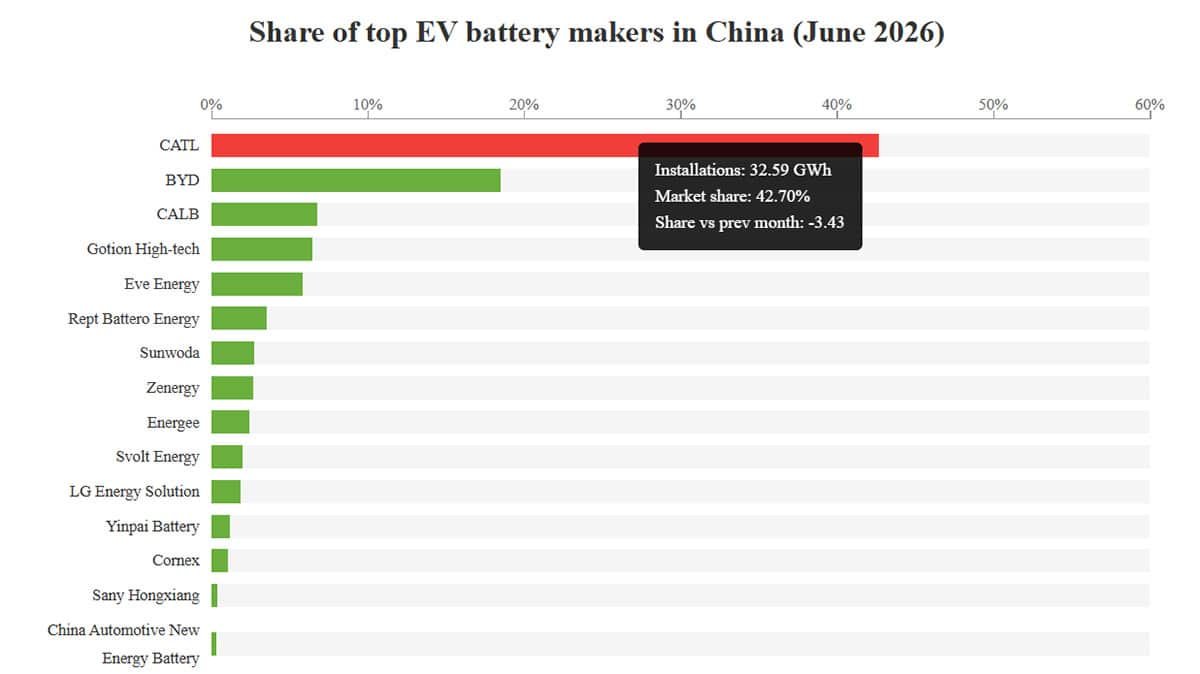
Source: CnEVPost (SNE Research data)
The top 10 rankings
Seven Chinese companies ranked among the world’s top 10 battery suppliers in the first half, with a combined 72.4% share, up 1.5 percentage points year-on-year. The full top 10:
- CATL: 242.7 GWh, 39.9% share
- BYD: 87.7 GWh, 14.4%
- LG Energy Solution: 52.6 GWh, 8.6%
- CALB: 31.2 GWh, 5.1%
- Gotion High-tech: 28.0 GWh, 4.6%
- Panasonic: 22.7 GWh, 3.7%
- Eve Energy: 20.9 GWh, 3.4%
- SK On: 19.0 GWh, 3.1%
- Svolt: 15.7 GWh, 2.6%
- Sunwoda: 14.5 GWh, 2.4%
SK On was the only top-10 supplier to record a decline in installations, with volume down 6.7% year-on-year. SNE Research attributed the drop to adjustments in EV sales and production plans by some customers in North America and Europe.
Outside the top 10, the market remains fragmented, and SNE’s data show regional suppliers such as Samsung SDI losing share. Samsung SDI’s installations in non-China markets fell 29.0% year-on-year to 10.5 GWh, even though it continues to supply BMW, Audi and Rivian — a reminder that supplying premium automakers is no longer enough to keep pace with Chinese scale.
CATL vs BYD: diverging growth
The two Chinese giants together control more than half of the global EV battery market, but their trajectories diverged sharply in the first half. CATL grew 25.3%, faster than the market, while BYD’s installations rose only 1.6%.
BYD’s share decline is a home-market story
BYD’s global share fell by 2.6 percentage points mainly because of slower growth in its domestic battery business, where the group faces competition from CATL and from other Chinese cell makers selling to automakers. BYD’s batteries are used primarily in its own vehicles, so its battery growth tracks its own NEV sales more than the broader market.
Outside China, BYD is accelerating
The picture changes outside China. BYD installed 28.2 GWh in the first half, up 67.9% year-on-year, lifting its share to 10.5% from 7.9% and ranking it third behind CATL, which added 90.5 GWh outside China for a 33.6% share. That overseas growth is a sign that BYD’s battery business is becoming more global as its vehicles expand into more markets.
LG Energy Solution’s growth lag
LG Energy Solution, the largest non-Chinese supplier, grew 8.4% to 52.6 GWh but still lost share, falling to 8.6% from 9.6%. Its customer list includes Tesla, Hyundai Motor Group, GM and Volkswagen, yet the overall market is growing so quickly that even solid absolute growth is not enough to hold share against Chinese rivals.

Source: Wikimedia Commons (public domain)
Seven Chinese suppliers in the top 10
Chinese suppliers now occupy seven of the top 10 positions, a concentration that carries implications for the whole industry. Smaller Chinese makers posted even steeper overseas growth: Gotion’s non-China volume rose 141.5%, Svolt’s 106.0%, CALB’s 80.5% and Eve Energy’s 171.5%.
Outside China, total installations reached 269.0 GWh in the first half, up 26.3% and outpacing the global market, as Chinese suppliers pushed further into Europe and other regions.
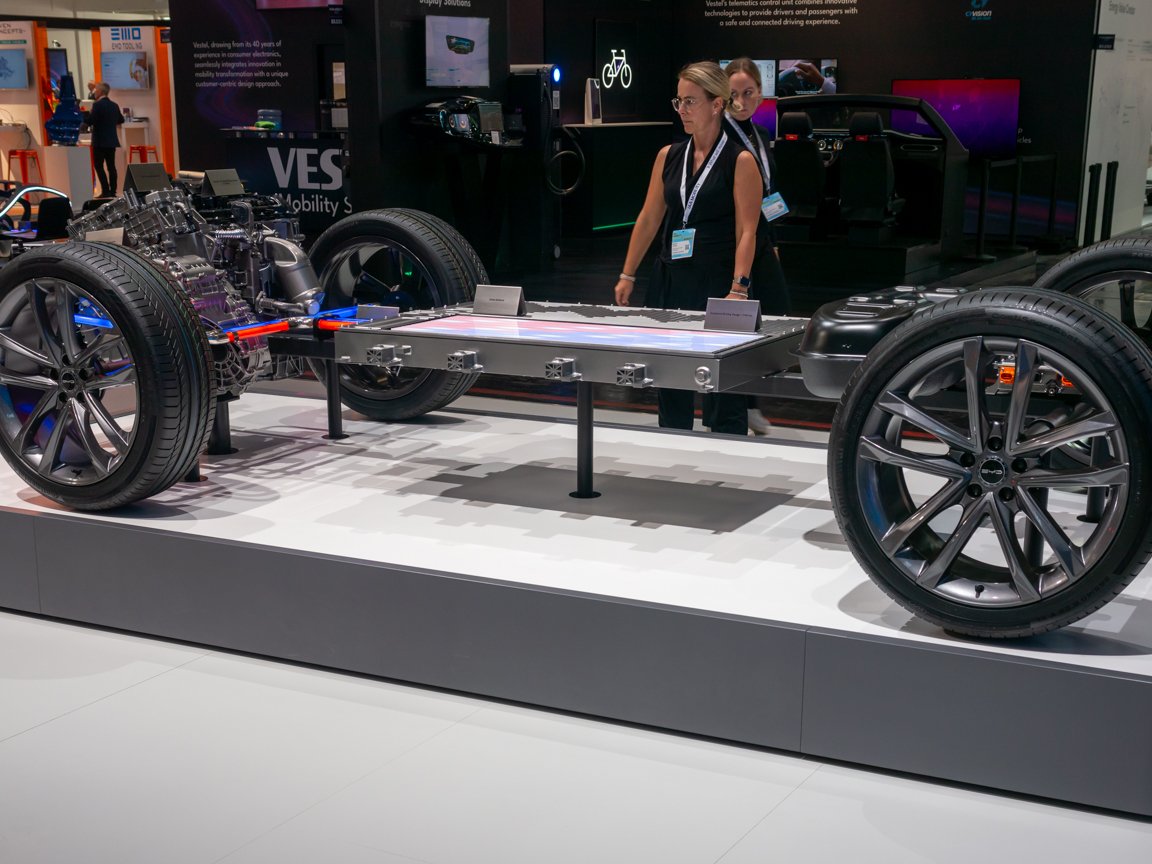
Source: Wikimedia Commons (CC BY-SA 4.0)
Why BYD’s battery business matters
For buyers and importers, the data show how concentrated the battery supply chain remains — and why BYD’s in-house Blade Battery production matters. BYD’s batteries are a core part of its NEV value proposition, and its faster overseas growth suggests the group is increasingly monetizing its technology outside China even as competition intensifies at home.
The second-generation Blade Battery, which supports flash charging, is expected to widen BYD’s technology lead in fast charging as it rolls out across new models. Battery performance — energy density, charging speed and safety — remains one of the strongest differentiators in the EV market, and both CATL and BYD are using it to defend premium positioning.
What it means for sourcing decisions
For importers and dealers, the concentration of supply in a handful of Chinese makers affects everything from availability to pricing power. Buyers who source EVs or batteries should track which cell suppliers back the models they import, since battery choice increasingly determines range, charging speed and resale value.
What to watch next
The next milestones are the full-year 2026 rankings, the ramp-up of BYD’s second-generation Blade Battery with flash charging, and whether the overseas share gains continue as European and North American demand evolves. Also watch whether CATL’s lead outside China grows further, as its European plants come online.
I’m Lucian from BYD Sourcing. With more than 10 years in the automotive industry and hands-on experience with export procedures and customs clearance, I help overseas buyers source Chinese EVs — especially BYD models — through official, verified channels, for both retail and wholesale. Contact us for a competitive quote.
Sources
- Global EV battery market share in H1 2026: CATL 39.9%, BYD 14.4% — CnEVPost
- SNE Research data, as reported by CnEVPost


 English
 Portuguese
 French
 Turkish
 Russian
 Arabic
 Spanish