
Mud flaps and splash guards can name the same wheel-behind accessory; “mudguard” can also mean the wider wheel-covering structure. None of those words, on its own, tells you whether a part is flexible, rigid or suitable for your car. Match its fitted position and mounting shape before choosing between listings.
If you are trying to reduce grit along your BYD’s lower body, start with the panel immediately behind the tyre. If you are replacing a torn shield inside the wheel opening, you need to identify a different part—even when its title also contains “splash”.
Find the part in the fitted photograph
| Where it goes | What to identify | Which purchase it points to |
|---|---|---|
| Immediately behind a tyre | A panel attached at the rear edge of the wheel opening, with an edge extending down behind the tyre. | A hanging flap or shaped splash guard. Compare the fitted outline, not just a photograph of the loose set. |
| Inside the wheel opening | A larger curved shield following the inner wheel well, with attachment points around its perimeter. | A wheel-arch liner. A small four-corner flap set does not replace this inner shield. |
| Around the outside of the wheel opening | A strip following the arch rather than a panel hanging behind the wheel. | Arch trim or a fender flare. Identify whether you need replacement trim or additional width before ordering. |
| Along a rear door opening | A long piece following the door/arch gap rather than hanging behind each of four wheels. | A door-gap liner panel, not an inner wheel-arch liner or a complete four-wheel flap set. |
The last distinction is easy to miss. The Sealion 06 EV rear-door liner listing specifies two ABS pieces for the rear door/arch gaps. “Liner mud flaps” in that title does not mean a replacement shield for the inside of the wheel well.
What a four-piece set actually tells you
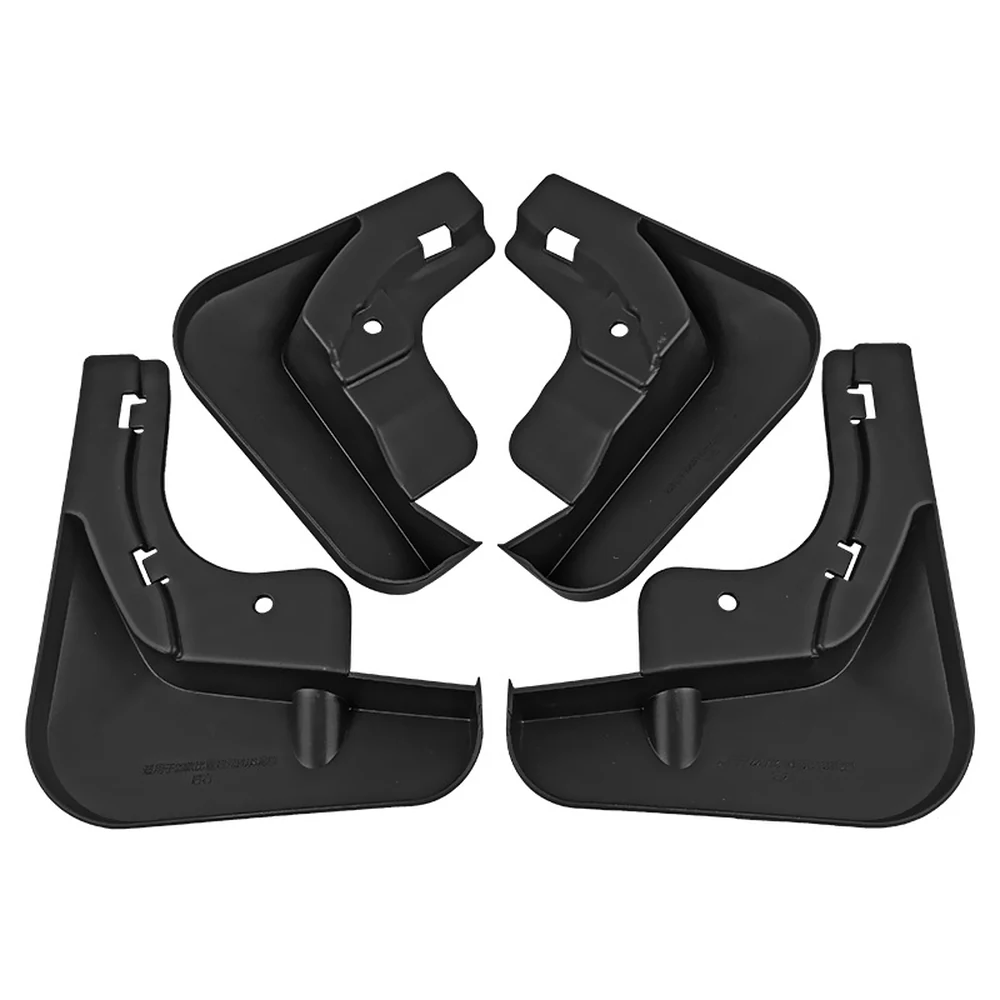
The Atto 3 set is listed as front and rear, left and right. Its four-piece count tells you which corners are supplied. It does not prove that a similar-looking four-piece set has the same holes, or that two pieces from different models are interchangeable.
Before comparing price or material, match three details: the edge that rests against the arch, the positions of the attachment holes, and the installed lower edge. If the first two differ, a matching name and colour do not resolve the mismatch.
Why “splash guard” does not always mean a short, hard part
There is no dependable soft-versus-hard split between these retail names. A useful counterexample is Tesla’s Model 3 installation instructions for 2017–2023 vehicles: the splash guard is attached to the mud flap with adhesive, and the instructions distinguish those two pieces within one system. That is a specific manufacturer’s terminology, not a rule for BYD listings.
For a shape comparison, look at a side-on installed photograph: where does the lower edge finish relative to the tyre and body? For flexibility, a bending photograph shows something different.
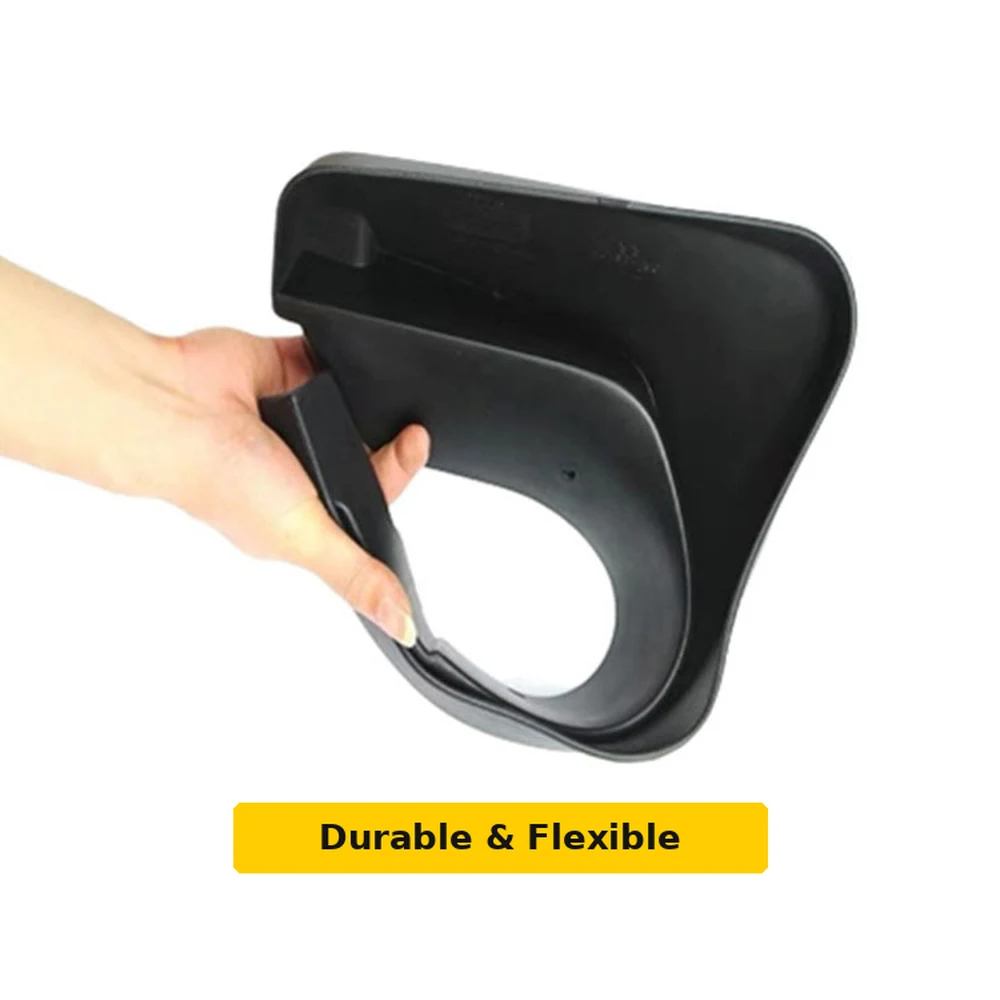
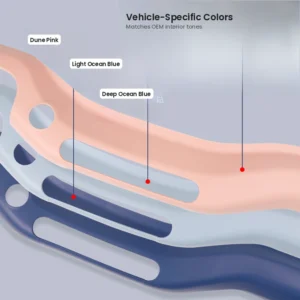
A short guard can be flexible; a longer one can be relatively stiff. A paint-matched finish is an appearance choice, not a material specification.
When “mudguard” includes the bodywork
In Queensland’s Vehicle Standards and Safety Regulation, Schedule 1, sections 3 and 32, a mudguard can be a device with or without a mudflap, and the body can act as the guard. A requirement referring to a mudguard therefore does not automatically mean you must buy an extra hanging accessory.
When asking a seller to identify a part, send one photograph showing its position on the car and another showing its outline and mounting points. State whether you need the wheel-behind panel, the inner shield or the door-gap piece. That description is more precise than asking for “splash guards” alone.

 English
 Portuguese
 French
 Turkish
 Russian
 Arabic
 Spanish