

Do body kits affect EV range? For a typical bolt-on kit of front lip, side skirts and rear diffuser, the effect on range is usually too small to notice in everyday driving. The parts are light, and any change in drag mostly shows up at motorway speeds. Parking sensors and driver-assist cameras matter more: a badly chosen or badly fitted part can block them.
This guide explains how exterior parts interact with an electric car’s range, its parking sensors, radar and cameras, and what to check before you fit anything. It is written for BYD owners, and for the shops and installers who fit parts for them.
If you are new to exterior upgrades, start with our guide to qu'est-ce qu'un kit carrosserie automobile.
Do body kits affect EV range?
Three things decide how much energy an electric car uses to move: aerodynamic drag, rolling resistance and weight. A body kit can touch the first and the last, but only lightly.
- Drag grows quickly with speed. Aerodynamic drag rises with the square of speed, so a small change in the car’s shape that is invisible in town can show up as a slightly higher energy figure on the motorway.
- Most styling parts are small. A front lip, side skirts and a bumper diffuser add a little to the car’s outline but do not change its basic shape. The effect can go either way: some lips tidy the airflow under the nose, others add frontal area.
- Weight is minor. Plastic lips, skirts and diffusers weigh far less than a passenger or a full boot of luggage, so their effect on range through weight is very small.
In short, you are unlikely to see a clear difference in your range readout after fitting a typical lip kit. Outside temperature, heating or air conditioning, tyre pressure and how fast you drive will move the number much more.
Be wary of claims in both directions. If a seller promises a range gain from a styling part, ask for test data for that exact part on that exact car. The same goes for forum posts that blame a lip for a big drop in range. A single trip is not a fair test because conditions change every time you drive.
What does reduce range noticeably?
Some changes have a bigger effect than a lip kit, and they are worth knowing about if range matters to you:
- Wider or heavier wheels and tyres. Wider tyres add rolling resistance and frontal area, and open wheel designs can add drag.
- Roof racks and roof boxes. Anything on the roof sits in fast, clean air and adds a lot of drag at motorway speed.
- Large raised wings. A tall wing is built to push the car down, and that comes with drag. Our article un spoiler arrière vaut-il le coup covers spoilers, wings and fuel or energy use in more detail.
- Driving style. Speed and hard acceleration matter more than any exterior part.
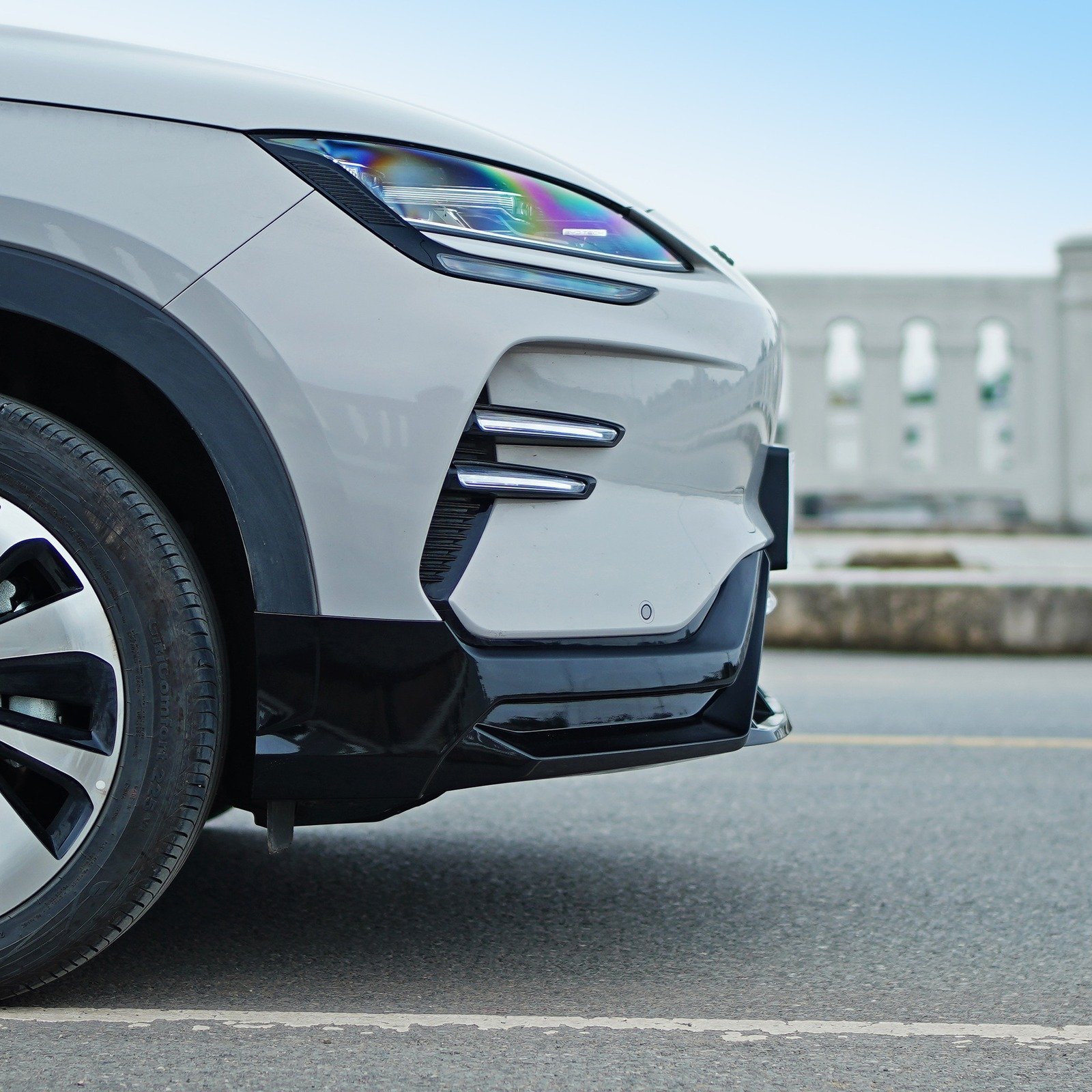
Body kits and parking sensors
Parking sensors are the small round discs set into the front and rear bumpers. They send out ultrasonic pulses and listen for the echo, so they need a clear view of the space around the car. Most problems after fitting a body kit come from one of these causes:
- A part sits in the sensor’s field of view. If a lip or diffuser sticks out far enough below or in front of a sensor, the sensor can pick it up as an obstacle. The usual symptom is a constant beep or a false warning with nothing near the car.
- A sensor hole is covered or misaligned. Replacement bumpers and some diffusers have openings for the sensors. If the openings do not line up, the sensors cannot sit flush and may give wrong readings.
- Thick paint over the sensors. Ultrasonic sensors are sensitive to heavy paint layers. If you are painting parts around them, ask your body shop to follow the car maker’s guidance for painting sensors.
- Loose wiring after bumper removal. If the bumper came off during fitting, a sensor plug may not be fully clipped back in.
A lip that follows the lower edge of the bumper normally sits below the sensors and does not get in their way. Deep diffusers and full replacement bumpers need more care because they sit closer to the sensors or carry them.
Vehicle-specific parts are shaped for the factory bumper, which makes it much easier to keep sensor areas clear than with a universal strip cut to fit. See kits carrosserie universels vs spécifiques au véhicule for how the two compare.
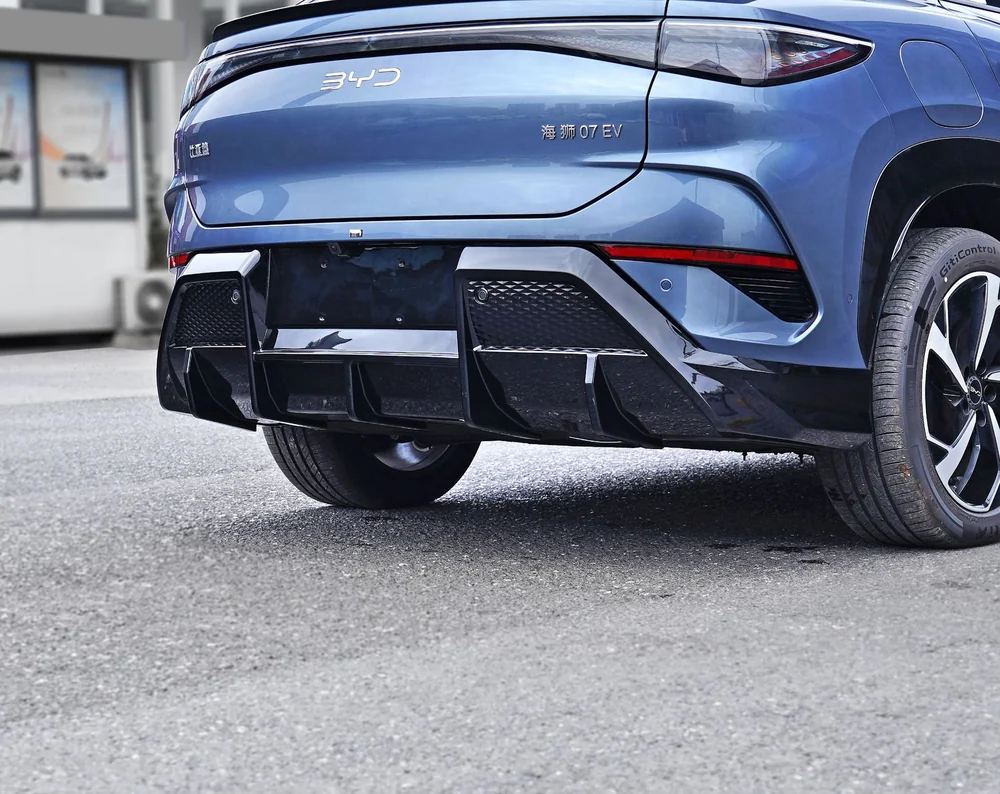
Body kits, radar and ADAS cameras
ADAS stands for advanced driver-assistance systems: features such as adaptive cruise control, automatic emergency braking, lane-keeping and 360-degree cameras. They rely on a mix of sensors placed around the car.
| Sensor | Where it is usually found | Which exterior parts can matter |
|---|---|---|
| Front radar | Behind the front bumper cover, lower grille or badge | Grille covers, badge overlays, replacement bumpers, metal or metallic-painted parts in front of the radar |
| Corner radar | Behind the bumper corners, front and rear | Replacement bumpers, corner add-ons, heavy paint or stickers over the corners |
| Windscreen camera | Behind the windscreen near the mirror | Not affected by body kits |
| Caméras de surveillance | Front grille or bumper, door mirrors, tailgate | Front lips can show at the bottom edge of the front view; mirror covers and tailgate trims near the lenses |
| Rear camera | Tailgate or boot lid, near the number plate | Rear trims or diffusers that sit too close to the lens |
Radar can see through plastic, but not well through metal, metallic paint or thick layers of material. That is why grille covers and badge overlays need more thought than a lip that sits low on the bumper. If a part goes anywhere near a radar location, check that it is designed for that position on your model.
Cameras are simpler. A low front lip may appear as a thin strip along the bottom of the front camera image, which is normal and does not affect parking guidance. What you must avoid is anything that covers a lens or changes the camera’s angle.
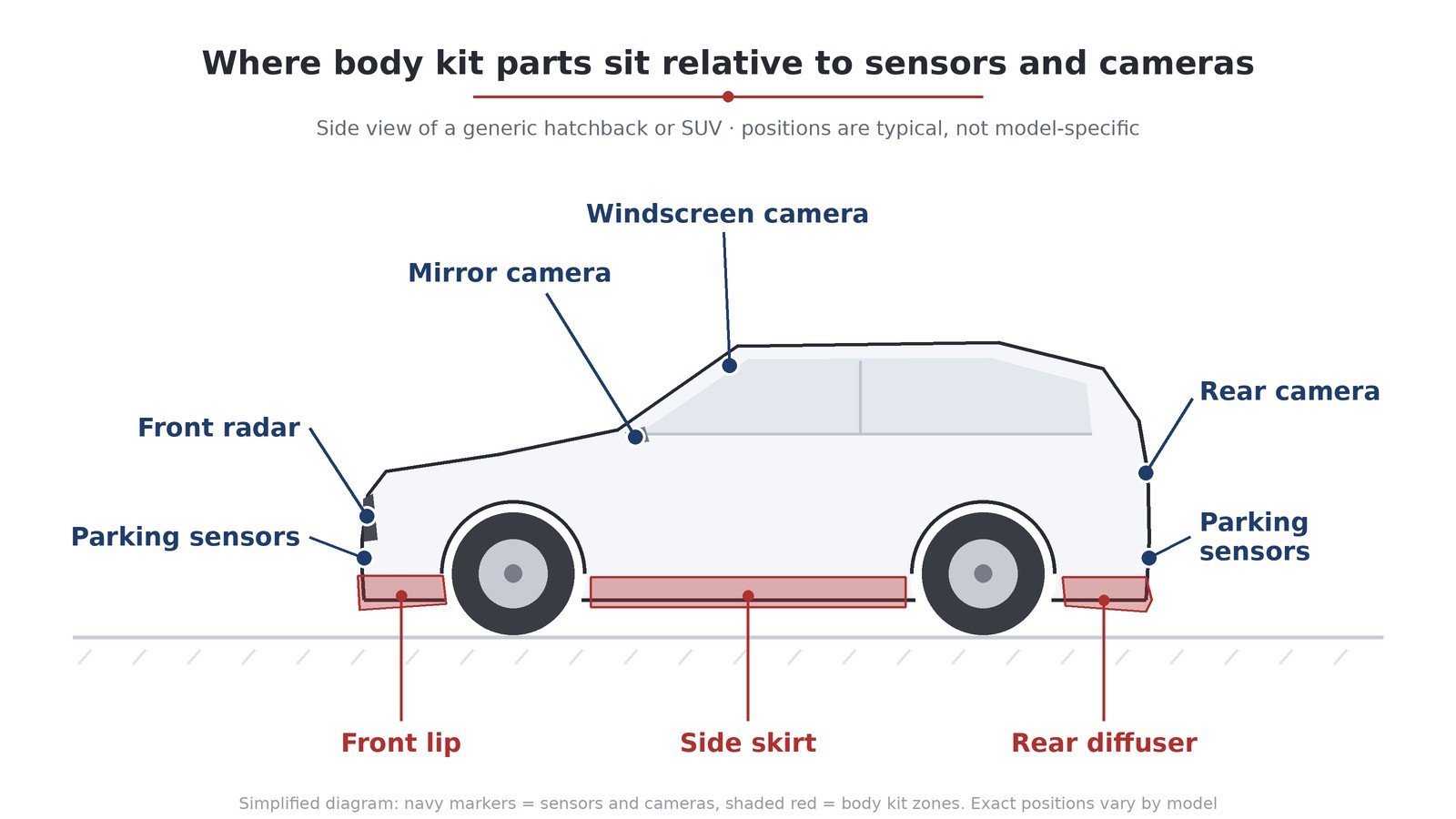
When is ADAS calibration needed?
Calibration means re-aiming a radar or camera so the car’s systems read distances and lane lines correctly. Car makers set out when it is required. As a general guide:
- Fitting a lip, skirts or a diffuser to the existing bumper without moving any sensor usually does not need calibration.
- Removing and refitting the front bumper, or replacing it, can disturb radar brackets. Many makers require a check or calibration after this.
- Anything that changes ride height, such as lowering springs, can affect camera and radar aim.
If a warning light appears, adaptive cruise switches off, or lane-keeping behaves differently after fitting, stop using those features and have the car checked by a workshop that can calibrate ADAS sensors.
What to check before fitting a body kit to an EV
A few checks before and after fitting save most of the trouble:
- Match the part to your exact model. Bumper shapes and sensor layouts change between models and versions. Our guide to full body kits or individual parts helps you plan what to fit first.
- Find your sensors first. Before ordering, note where the parking sensors, radar and cameras are on your car, and compare that with the product photos.
- Check whether the bumper must come off. If it does, ask your installer whether the car will need an ADAS check afterwards. Our step-by-step guide on comment installer un kit de carrosserie covers the fitting process.
- Keep sensor areas clean. Don’t run tape, sealant or paint across sensors or lenses.
- Test after fitting. Walk around the car with the parking sensors on, reverse slowly towards a wall, and check the 360-degree camera view. On the road, confirm adaptive cruise and lane-keeping work as before.
- Think about ground clearance. A deeper lip will not change range much, but it can scrape on ramps and driveways.
For a full budget including paint and labour, see combien coûte un kit carrosserie. Most Marvix exterior styling parts are ABS, with PP on selected kits; our guide to PP vs ABS vs fibre de verre vs fibre de carbone explains the differences.
Fitting body kit parts to a BYD EV
BYD models come with different combinations of parking sensors, radar and surround-view cameras depending on model, version and market, so the safest approach is to choose parts made for your car and check them against your own bumper.
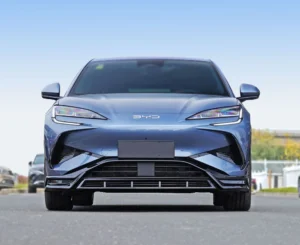
On the BYD Sealion 7, the lèvre de pare-chocs avant pour BYD Sealion 7 mounts to the lower edge of the front bumper, and the diffuseur de pare-chocs arrière pour BYD Sealion 7 finishes the rear. You can see the whole range on accessoires BYD Sealion 7.
Pour le SUV hybride rechargeable, le front bumper lip for BYD Seal U DM-i (Song Plus) follows the lower front bumper. More parts are on the BYD Song Plus DM-i / SEAL U DM-i page.
Seal owners can see how a full set of parts works together in our guide de kit carrosserie BYD Seal. To browse by part, start with Lèvres de pare-chocs avant BYD et Pare-chocs arrière et diffuseurs BYD.
Not sure where the sensors are on your version? Send us the model, year and photos of the front and rear bumper through notre page de contact, and we will check the fit before you order.
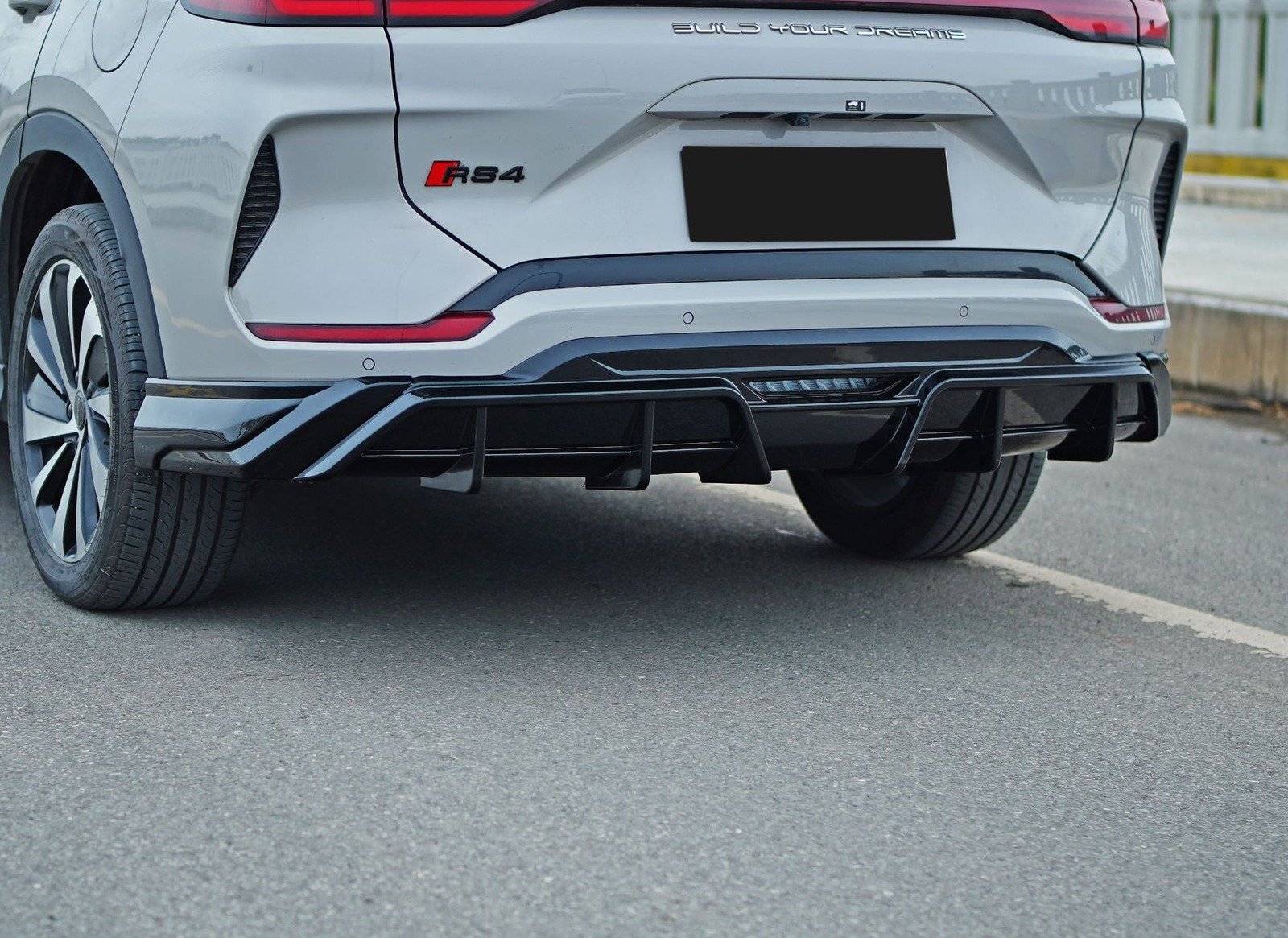
Foire aux questions
Do body kits affect EV range?
A typical bolt-on kit of front lip, side skirts and rear diffuser has very little effect. The parts are light, and any change in drag is small and mostly appears at motorway speeds. Weather, speed and tyre pressure affect range far more.
Can a front lip set off my parking sensors?
It can if the lip sticks out into the sensor’s field of view or covers a sensor. A lip made for your model that follows the lower edge of the bumper normally sits below the sensors and does not trigger them.
Will a body kit affect adaptive cruise control?
Not if nothing is placed in front of the radar and the radar is not moved. Grille covers, badge overlays and replacement bumpers need the most care. If adaptive cruise switches off or shows a warning after fitting, have the radar checked.
Do I need ADAS calibration after fitting a body kit?
Usually not for add-on parts fitted to the existing bumper. If the bumper was removed or replaced, or the ride height changed, follow the car maker’s guidance and ask a qualified workshop whether calibration is needed.
Can I paint body kit parts near the sensors?
Yes, but keep paint off the sensors themselves unless your body shop follows the car maker’s guidance. Heavy paint layers can affect how ultrasonic sensors read.
Un diffuseur arrière améliore-t-il l'autonomie d'un VE ?
Do not count on it. A bumper-mounted diffuser is mainly a styling part, and any change in drag is likely to be too small to notice in daily driving.
Shop BYD exterior parts or wholesale stock with Marvix
Marvix est un partenaire BYD tout-en-un : une expérience dans l'export de véhicules BYD, plus des pièces extérieures, des accessoires et de la logistique d'export. Nous exploitons une ligne de production dédiée aux pièces en plastique avec outillage interne, une grande bibliothèque de moules et un entrepôt et site de production de plus de 2 000 m², et de nombreux modèles BYD sont déjà outillés.
Les échantillons à l'unité et les commandes au détail sont acceptés, avec des prix dégressifs à mesure que les quantités augmentent. Les pièces listées sont généralement en stock, et les commandes de moins de 100 ensembles sont expédiées directement sans délai de production. Nous prenons également en charge les commandes multi-références, le dropshipping et les vérifications de compatibilité à partir du modèle/année, du VIN, du numéro de pièce ou de photos.
Conditions d'expédition pour les grandes pièces : Brésil, Colombie et Mexique : EXW, FOB ou DAP uniquement (l'acheteur gère le dédouanement et les taxes). Tous les autres pays : EXW, FOB et DAP, plus DDP pour les échantillons, les commandes au détail et le dropshipping. Les détails sont sur notre politique d'expédition pour les accessoires BYD.
Parcourez kits carrosserie BYD, consultez les conditions commerciales sur Vente en gros d'accessoires extérieurs BYD, ou demandez un devis avec votre modèle et vos photos.

 English
 Portuguese
 French
 Turkish
 Russian
 Arabic
 Spanish